When decorative lighting products enter different countries and regions, they must comply with the applicable safety, environmental, and market access requirements. Insufficient certification preparation may delay customs clearance, affect project approval, disrupt installation acceptance, and impact subsequent sales.
This article from Postmodernlighting provides a systematic overview of the most common certifications and compliance requirements in the decorative lighting industry, including UL, ETL, CE, and RoHS. It also explains the differences between these requirements, their target markets, common misconceptions, and key procurement review points, helping you select the right certification strategy for your target market while reducing export and project risks.
1. Why Decorative Lighting Certification Matters
Compliance requirements for decorative lighting vary across different markets. You should determine the appropriate certification based on the product type, installation environment, and target sales region. Before selecting a certification, it is important to understand how compliance directly affects product safety, market access, and project acceptance.

Lighting Certification Testing
1) Certification Improves Product Safety and Reduces Operational Risk
Decorative lighting is an electrical product, and its safety depends not only on the design but also on compliance with the applicable safety standards. Certifications such as UL and ETL typically evaluate electrical safety, insulation performance, temperature rise, grounding continuity, and mechanical construction to reduce the risks of electric shock, overheating, and fire.
For long-term applications such as hotels and commercial buildings, certified products generally provide more reliable quality and lower maintenance risks throughout the service life.
2) Certification Affects Market Access, Customs Clearance, and Project Acceptance
Different countries and regions apply different regulatory requirements. For example, projects in the United States typically require UL or ETL certification, while products sold in the European Union generally require CE marking and compliance with regulations such as RoHS. If a product does not meet the certification requirements of its target market, it may be excluded from project procurement, delayed at customs, or fail final project acceptance.
2. What Are the Most Common Certifications for Decorative Lighting?
Each certification serves a different market and regulatory framework. No single certification applies worldwide.
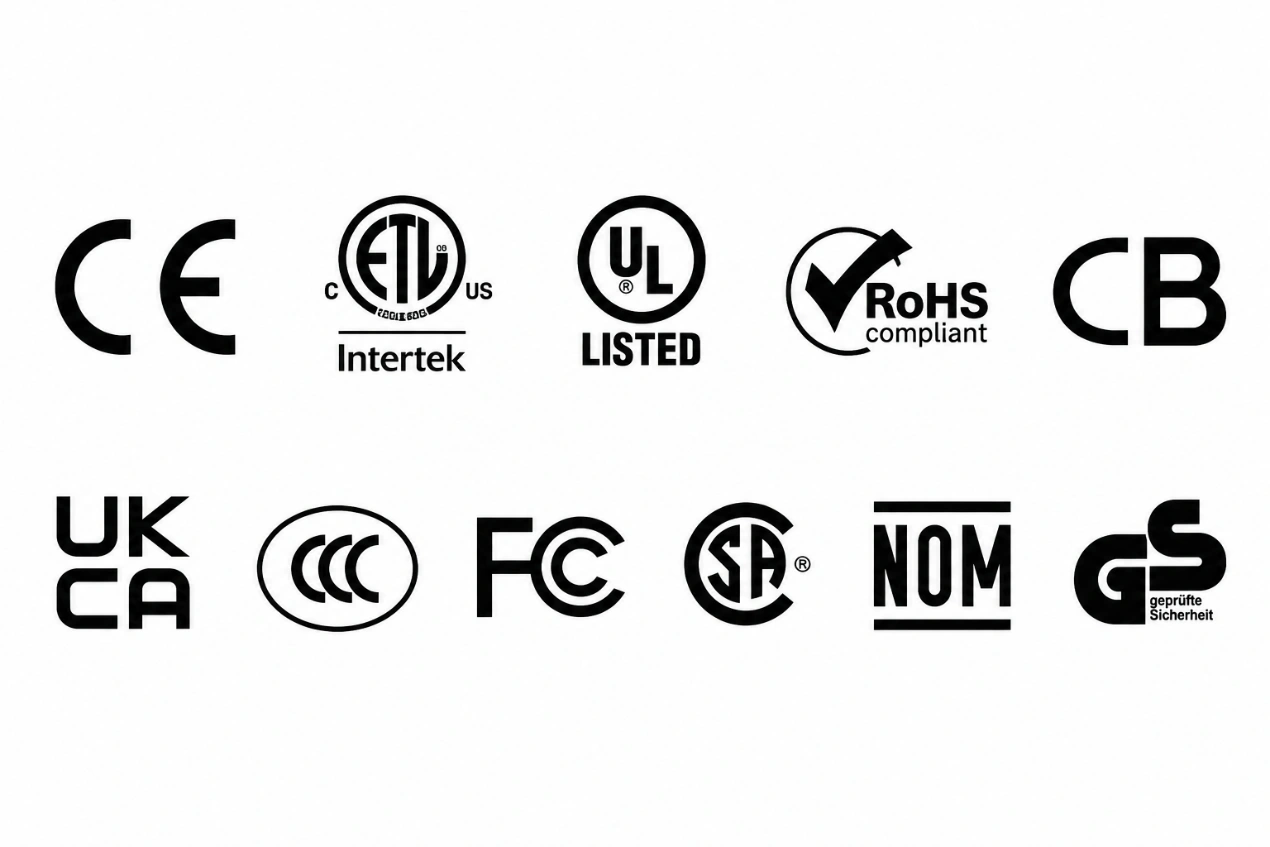
Common Decorative Lighting Certifications
1) UL Certification
UL (Underwriters Laboratories) is one of the most influential product safety certifications in the United States. It primarily evaluates electrical safety and fire safety. Many commercial buildings, hotels, hospitals, and public infrastructure projects in the U.S. give priority to UL-certified products.
2) ETL Certification
ETL is issued by Intertek and is also a recognized North American safety certification. As long as a product complies with the same ANSI/UL standards, ETL has the same legal recognition as UL and is accepted in both the United States and Canada.
3) CE Marking
CE is not a certification issued by a specific organization. Instead, it is a conformity mark indicating that a product complies with applicable European Union regulations. For decorative lighting products, CE compliance typically involves directives such as the Low Voltage Directive (LVD) and the Electromagnetic Compatibility Directive (EMC). CE marking is one of the essential requirements for entering the EU market.
4) RoHS Compliance
RoHS restricts the use of hazardous substances such as lead (Pb), mercury (Hg), and cadmium (Cd) in electrical and electronic products. The current EU RoHS Directive restricts ten hazardous substances. Components such as PCBs, power supplies, cables, and solder used in lighting fixtures must comply with these limits.
It is important to note that RoHS is an environmental regulation and cannot replace product safety certifications.
5) Certification Overview (Comparison Table)
| Certification | Primary Market | Main Scope | Safety Certification |
| UL | United States | Electrical safety, structural safety, fire safety | ✓ |
| ETL | United States, Canada | Safety testing to ANSI/UL standards | ✓ |
| CE | EU Member States (UK requires UKCA separately) | Compliance with EU directives (LVD, EMC, etc.) | ✓ (Regulatory Compliance) |
| RoHS | European Union, Türkiye, and other mutually recognized markets | Restriction of hazardous substances | ✗ (Environmental Regulation) |
Note: Some buyers mistakenly believe that CE marking alone allows products to be sold worldwide. In practice, U.S. engineering projects usually still require UL or ETL certification. Likewise, UL certification does not replace CE marking or RoHS compliance.
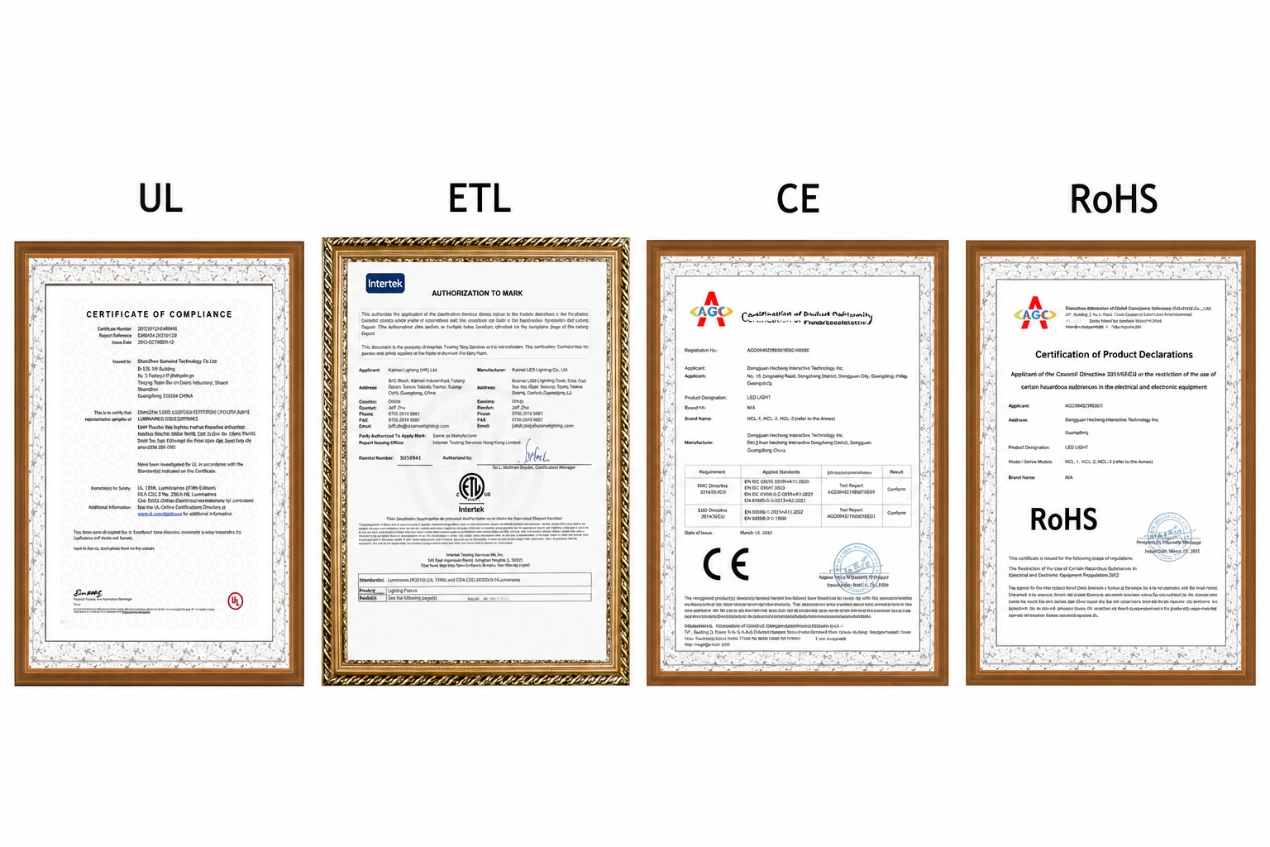
UL/ETL/CE/RoHS Certified
3. UL Certification: Which Decorative Lighting Products Require UL Certification?
Before determining whether a lighting fixture requires UL certification, it is important to understand what UL evaluates and how these requirements apply to decorative lighting products.
1) What Does UL Certification Cover?
UL (Underwriters Laboratories) is one of the oldest product safety certification organizations in the United States. Its primary objective is to verify that a product remains safe under both normal operating conditions and reasonably foreseeable misuse.
For decorative lighting products, UL certification typically evaluates the following:
a) Electrical safety: Protection against electric shock, dielectric strength, temperature rise and heat dissipation, grounding continuity, conductor and terminal safety, driver reliability, and material flame resistance.
b) Mechanical safety: A suspended chandelier must pass a load test equal to four times its own weight for one continuous hour, while cable tensile strength, strain relief, and moisture and water resistance for outdoor fixtures are also evaluated.
c) Labeling and production consistency: Permanent product labels must identify the model number, voltage, and environmental rating (Dry Location / Damp Location).
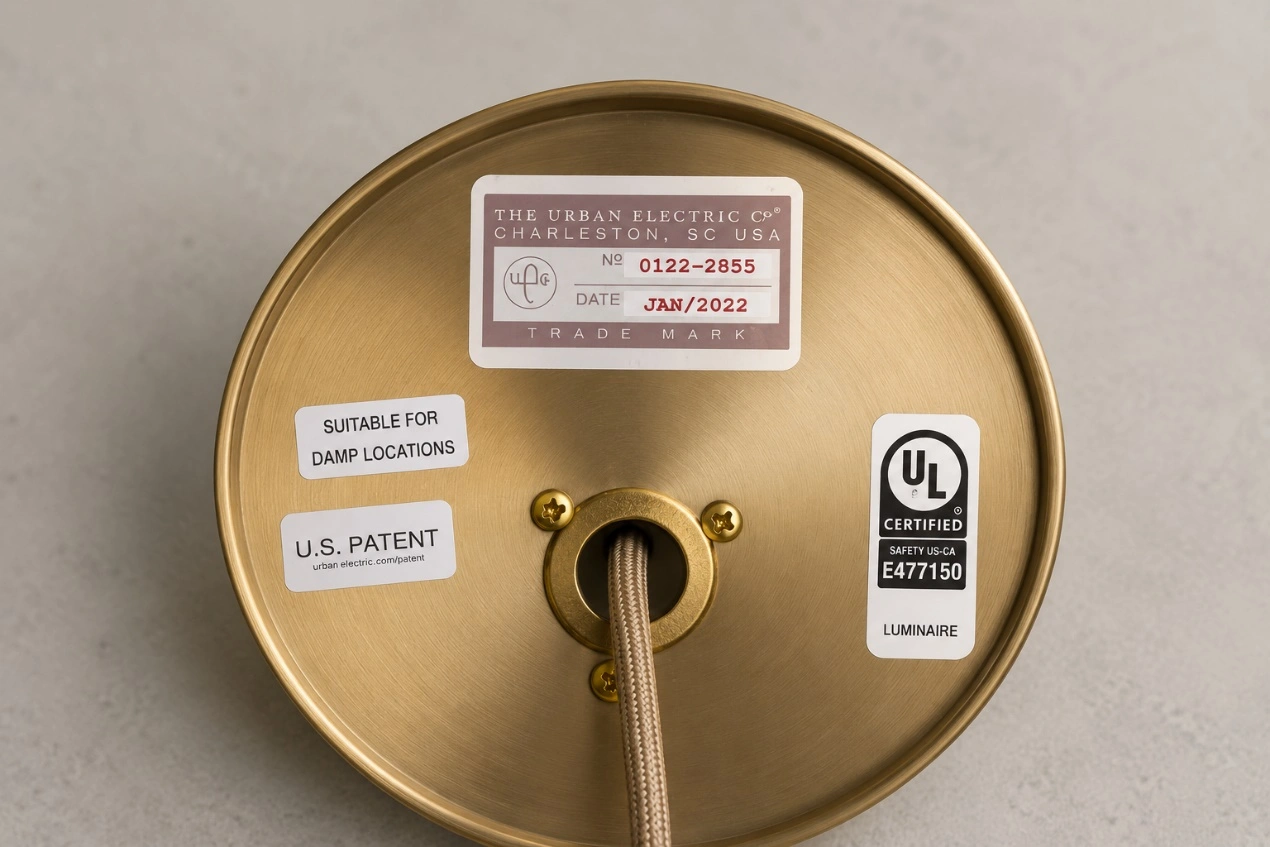
UL Label
2) Which Decorative Lighting Products Typically Require UL Certification?
Whether UL certification is required depends primarily on the target market and project specifications. In general, the following decorative lighting products are commonly required to comply with UL standards:
Pendant lights, wall lights, ceiling lights, floor lamps, table lamps, and other common decorative lighting products typically require UL certification when sold in the United States. For hotels, commercial complexes, office buildings, chain retail stores, and similar engineering projects in the U.S., procurement specifications usually require lighting fixtures to carry UL or ETL certification. Even if the product functions properly, it may fail project approval or on-site acceptance if the supplier cannot provide the required certification.
Common Misconception: Some buyers assume that using UL-certified drivers or wires automatically makes the complete lighting fixture a UL-certified product. These are two different concepts. UL certification of individual components does not mean the complete luminaire has obtained UL certification. If the project specifies UL Listed or UL Certified products, the entire fixture normally must complete the required testing and certification rather than simply incorporating UL-recognized components.
4. ETL Certification: How Does It Differ from UL?
ETL and UL follow the same ANSI/UL safety standards but are issued by different certification bodies. The following sections compare them in terms of testing scope, market acceptance, and typical applications.
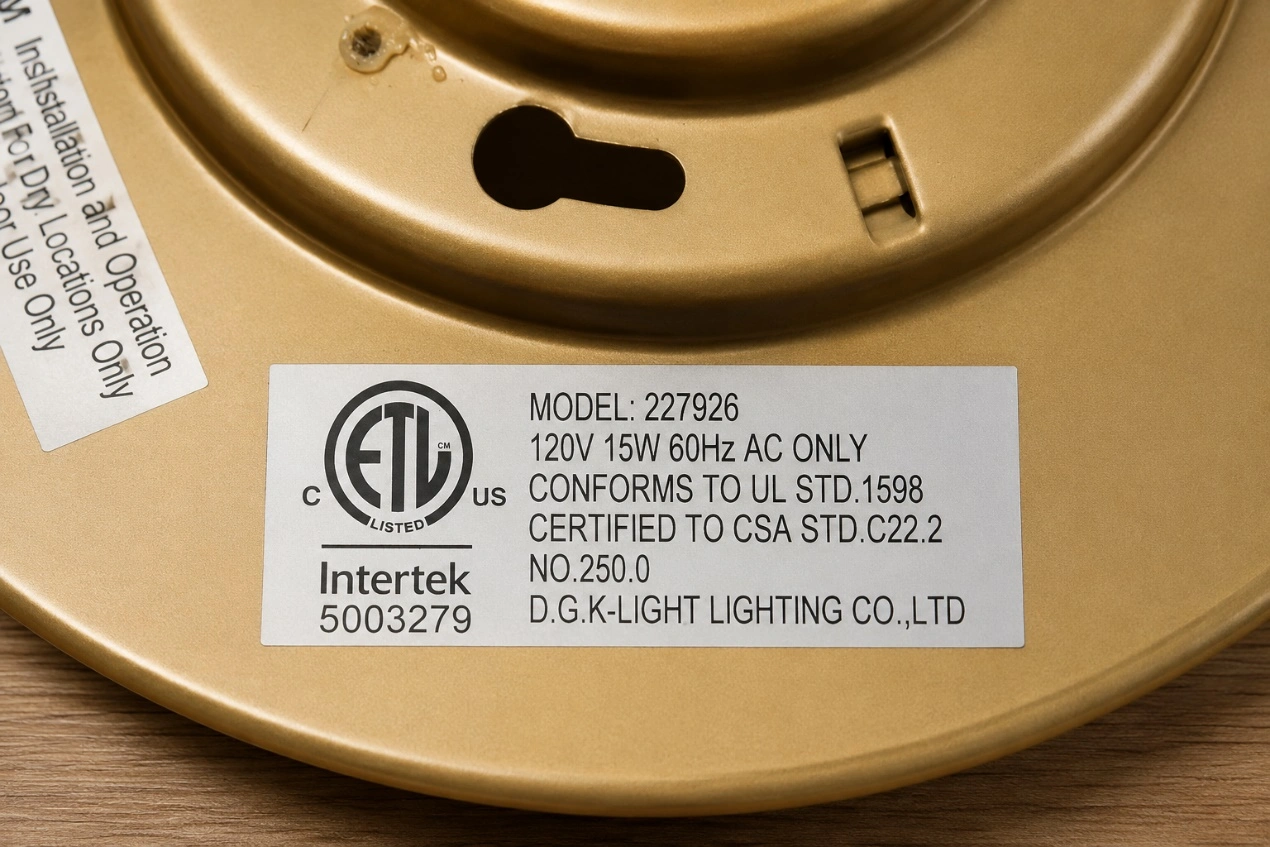
ETL Label
1) What Does ETL Certification Cover?
ETL (Electrical Testing Laboratories), issued by Intertek, is one of the NRTLs (Nationally Recognized Testing Laboratories) recognized by OSHA in the United States. For decorative lighting products, ETL testing follows the same ANSI/UL standards rather than a different safety standard. The testing scope is essentially the same as UL.
From a technical perspective, both ETL and UL evaluate whether a product complies with U.S. electrical safety requirements.
2) Does ETL Have the Same Market Acceptance as UL?
Whether a product carries UL or ETL certification, it has the same legal recognition in the United States as long as it has been tested to the same ANSI/UL standards and certified by an OSHA-recognized NRTL. Most building inspections, commercial projects, and insurance companies accept ETL Listed products in the same way they accept UL Listed products. The primary difference lies in the certification organization rather than the technical requirements.
3) When Should You Choose ETL Certification?
For decorative lighting products exported to the United States, ETL is often a practical and widely accepted choice if the customer does not specifically require UL certification. Many lighting manufacturers choose ETL for the following reasons:
- Certification lead times are generally shorter, helping accelerate new product launches.
- Communication is typically more efficient, and the certification process is relatively flexible.
- In some projects, ETL offers a more cost-effective certification process, with lower costs for future certificate updates.
- ETL fully satisfies the safety requirements of both the U.S. and Canadian markets.
It should be noted that some high-end municipal projects and certain long-established U.S. hotel brands explicitly specify “UL Only” in their procurement documents. In such cases, you should follow the project requirements.
5. CE Marking: Which Decorative Lighting Products Require CE Marking?
The compliance framework for decorative lighting in the European Union differs from that of the United States. CE marking is one of the core requirements for market access in the EU. The following sections explain the applicable regulations and the types of products that require CE marking.
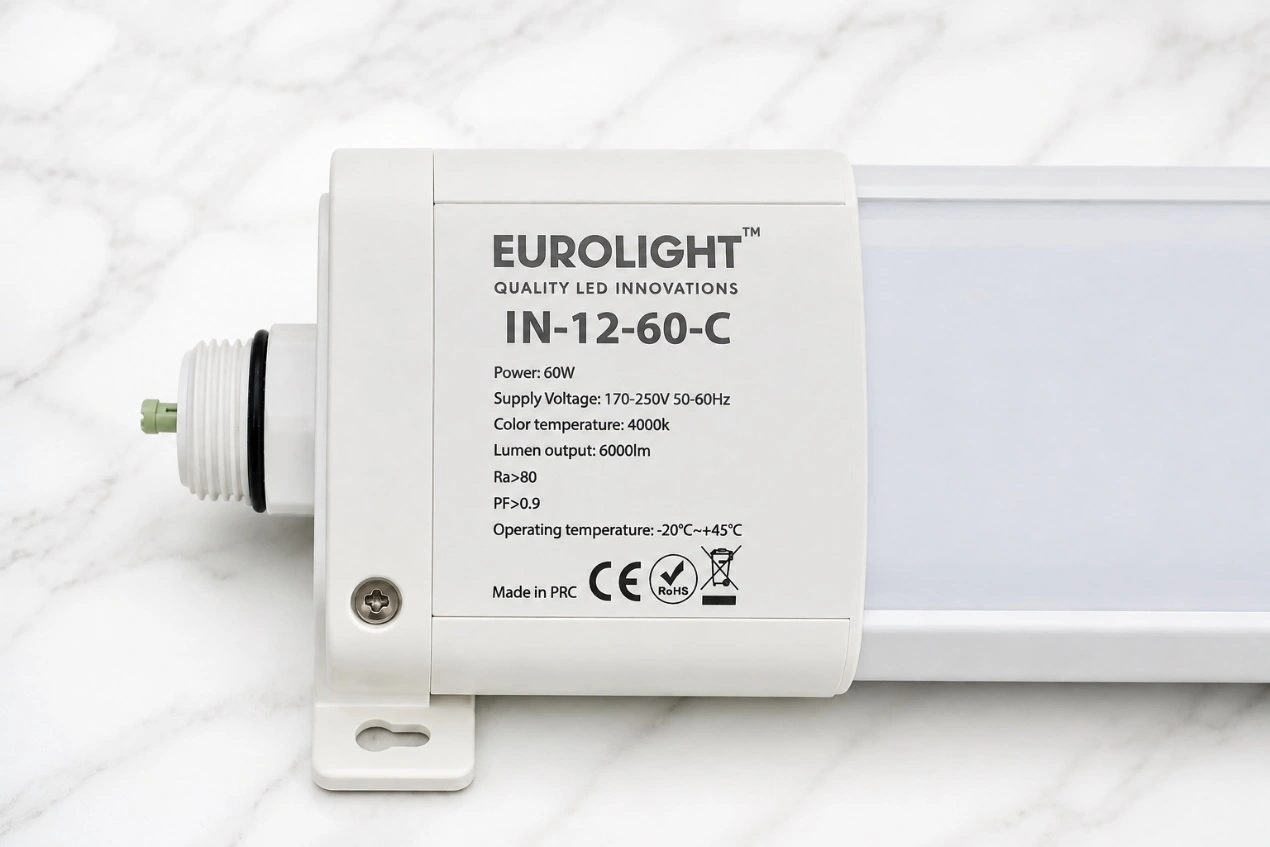
CE Label
1) What Does CE Marking Cover?
Unlike UL and ETL, CE is not an independent certification. It is a conformity marking indicating that a product complies with applicable European Union regulations. For decorative lighting products, CE compliance typically involves the following legislation:
- LVD (Low Voltage Directive): Ensures electrical safety.
- EMC (Electromagnetic Compatibility Directive): Ensures the product neither generates nor suffers unacceptable electromagnetic interference.
- RoHS Directive: Restricts the use of hazardous substances (typically required together with CE compliance).
Additional requirements may apply depending on the product: ErP Directive for LED decorative lighting. RED (Radio Equipment Directive) for smart decorative lighting with wireless technologies such as Bluetooth.
After completing the required testing, the manufacturer must prepare a Technical File, sign an EU Declaration of Conformity (DoC), and affix the CE marking to the product.
2) Which Decorative Lighting Products Typically Require CE Marking?
In principle, all decorative lighting products sold or placed into service within the European Union should comply with the applicable CE requirements, including but not limited to:
- Chandeliers
- Wall Lights
- Ceiling Lights
- Table Lamps and Floor Lamps
- Custom lighting for hotels and commercial projects
For engineering projects such as hotels, commercial complexes, and office buildings, buyers often require more than the CE mark itself. Suppliers are commonly asked to provide the EU Declaration of Conformity (DoC), test reports, and the Technical File to support project approval or import compliance.
6. RoHS Compliance: Which Decorative Lighting Products Must Comply with RoHS?
Unlike UL, ETL, and CE, which primarily focus on product safety and market access, RoHS regulates the use of hazardous substances in lighting products. The following sections explain the scope of RoHS requirements and how they apply to decorative lighting products.
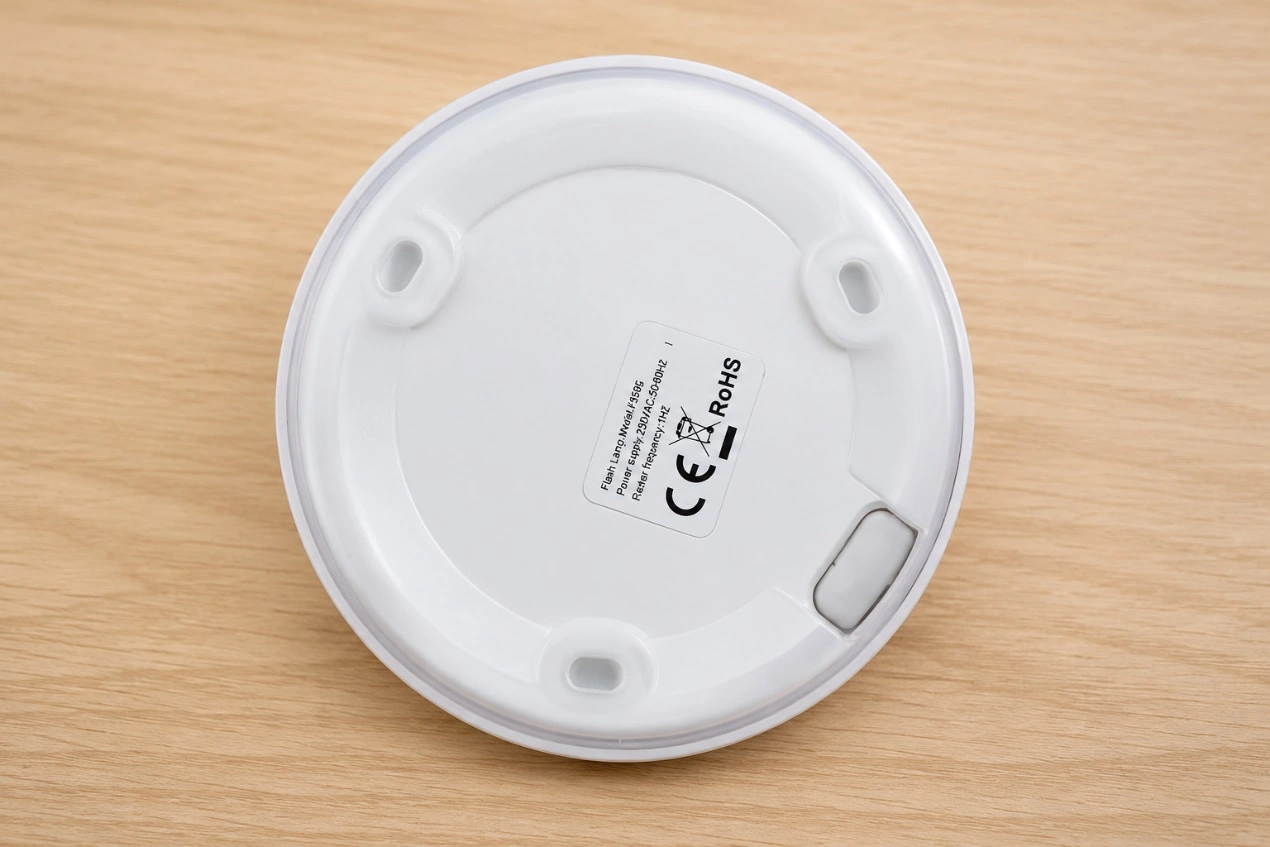
RoHS Label
1) What Does RoHS Compliance Cover?
RoHS (Restriction of Hazardous Substances) is an EU environmental regulation that restricts the use of hazardous substances in electrical and electronic equipment. It currently limits ten hazardous substances, including lead (Pb), mercury (Hg), cadmium (Cd), hexavalent chromium (Cr⁶⁺), and certain phthalates. The maximum permitted concentration is 0.1% for lead and 0.01% for cadmium.
For decorative lighting products, RoHS testing typically covers the following components:
- LED light sources and drivers
- PCB assemblies
- Solder and electronic components
- Wires, cables, and insulation materials
- Plastic parts and connectors
It is important to note that RoHS is an environmental regulation and does not evaluate electrical safety. Therefore, it cannot replace safety requirements such as UL, ETL, or CE.
2) Which Decorative Lighting Products Typically Require RoHS Compliance?
In general, all decorative lighting products sold in the European Union are expected to comply with RoHS requirements, including chandeliers, wall lights, ceiling lights, table lamps, floor lamps, and custom lighting for hotel and commercial projects.
Although metal frames, glass, and natural stone are not usually the primary focus of RoHS testing, internal electronic components, power supplies, wiring, and soldering materials are commonly reviewed during supplier audits and laboratory testing. RoHS compliance applies to the complete luminaire. If any critical electronic component exceeds the permitted limits, the entire product may fail to comply with RoHS.
It should also be noted that there is no general RoHS exemption for brass hardware. Some antique brass canopies and mounting brackets contain added lead to improve machinability, making lead-content limits easier to exceed. While RoHS provides certain exemptions for lead in glass, these exemptions are not unlimited. Recycled crystal materials are also more likely to exceed the allowable limits, so material composition reports should be retained for verification.
7. How to Verify Whether Decorative Lighting Certifications Are Valid
During lighting procurement, certification documents alone do not guarantee compliance. You should also verify whether the certification is authentic, remains valid, and matches the actual product being supplied. The following sections outline the key points to review.
1) Why Certification Documents Alone Are Not Enough
Many buyers ask suppliers to provide UL, ETL, CE, or RoHS documentation during the qualification process. However, having certification documents does not necessarily mean the current product is certified.
- Common issues include:
- Using expired certification documents.
- Certification documents that cover a different product model.
- Certification that applies only to individual components rather than the complete luminaire.
- Using test reports from another product to support the current product.
For this reason, buyers should not rely solely on the certificate title. They should verify that the certification specifically applies to the product being purchased.
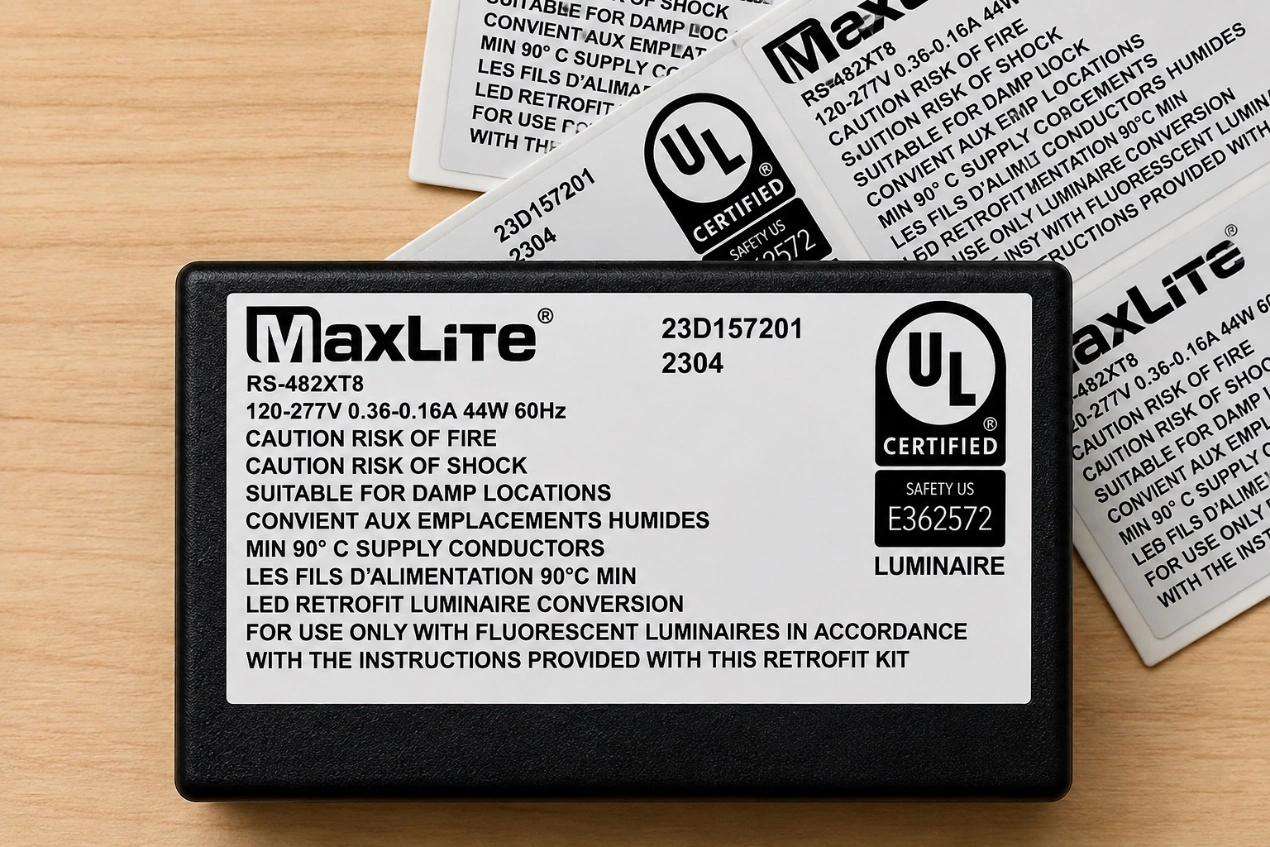
Certification Label Information
2) How to Confirm That the Certification Applies to the Actual Product
After receiving the certification documents, verify the following information carefully:
| Check Item | Verification |
| Product Model | Matches the purchased product |
| Manufacturer | Matches the supplier |
| Certification Status | Still valid |
| Certification Scope | Covers the current product category |
| Certification Body | Issued by a recognized certification organization |
For UL and ETL certifications, you can also verify the product model or certification number through the certification body’s official website to confirm that the certification remains valid.
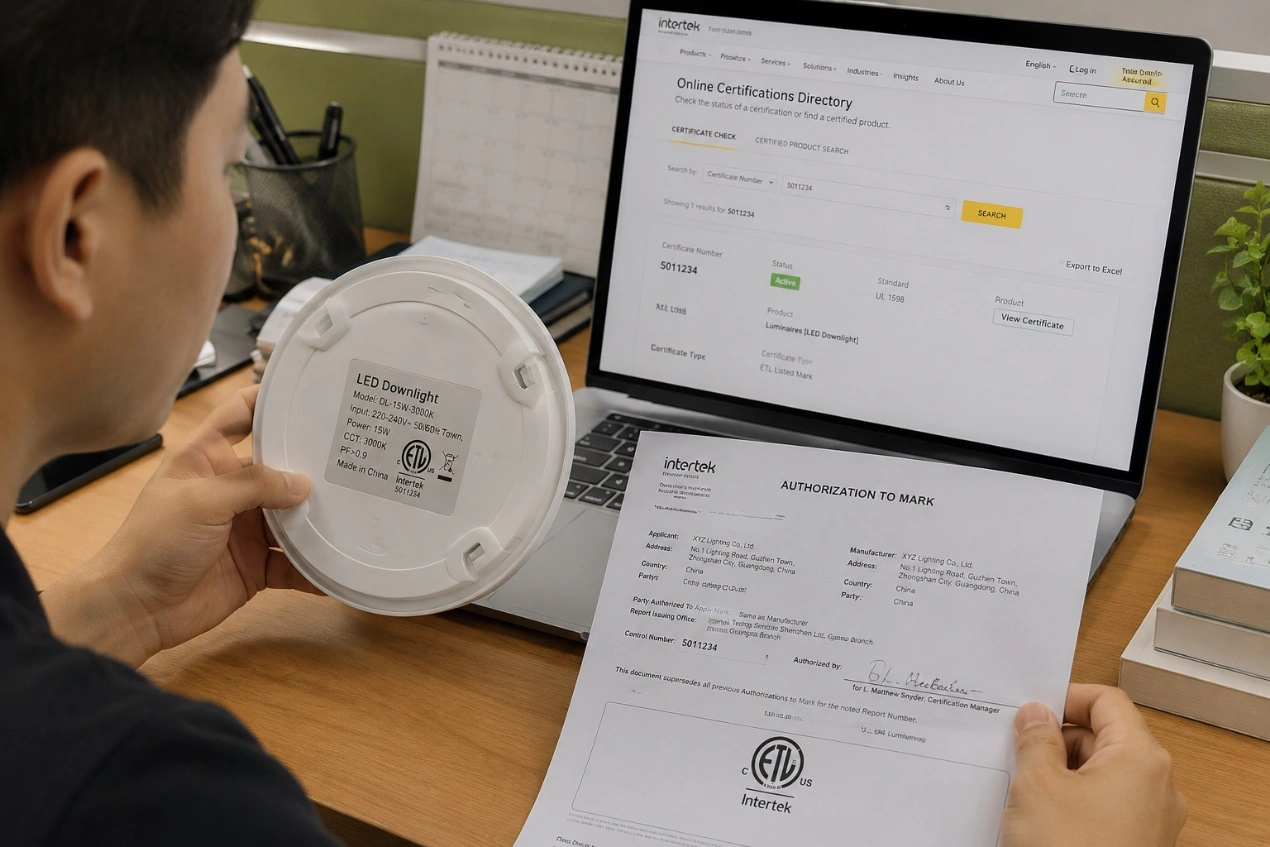
Verify the Certificate Date and Certification Scope
3) How to Identify Invalid or High-Risk Certifications
During procurement, pay particular attention to the following situations:
The certification cannot be verified through the certification body’s official database. Always check the certification number using the official UL or Intertek verification system instead of relying only on a certificate screenshot.
The certificate has been suspended, expired, or withdrawn. Verify its current status on the certification body’s official website rather than checking only the issue date.
The certified model does not match the model shown on the product nameplate. Confirm that the product model and manufacturer listed on the certificate exactly match the purchased product.
The product structure has changed, but the supplier continues to use the original certification. Changes to drivers, power supplies, wiring, or critical structural components generally require a new certification assessment.
A component Recognition certificate is presented as a complete luminaire Listing certificate. Certification of individual components does not mean the complete luminaire is certified.
CE documentation includes only test reports but does not provide the EU Declaration of Conformity (DoC) or the Technical File (TCF). This may present compliance risks in the EU market.
The RoHS report covers only selected electronic components while excluding key materials such as brass hardware, plastic parts, or wiring. Confirm that the testing scope covers all major controlled components used in the complete luminaire.
8. Conclusion
Whether you are developing a new product or sourcing decorative lighting for a hotel, residential, or commercial project, confirming the certification requirements early can significantly reduce the risk of product modifications, project delays, and compliance issues.
Postmodern Lighting can help determine the certifications required for your target market, including the United States, the European Union, and other regions. We also provide technical documentation, test reports, and project support to help your decorative lighting products enter the target market smoothly.