
Decorative lighting in restaurants has an impact on the food, the way the person’s face looks, the depth of the space and dining atmosphere. Decorative fixtures (pendants, wall sconces, table lamps and chandeliers) can be used to layer lighting with functional fixtures (downlights and spotlights) to provide different lighting layers for dining tables, walls, circulation paths and feature areas.
Based on Postmodern Lighting’s experience in decoratively lit hotel, restaurant and commercial projects, this guide discusses the most popular and useful fixture selections, important lighting parameters and fixture applications for each area of your restaurant to assist you in the selection and application of decorative fixtures to your project.
1. Role of Decorative Lighting in Restaurants
Decorative lighting in restaurants mainly serves the following functions:
1) Create the Dining Atmosphere and Spatial Visual Hierarchy
The use of varying fixture heights and intensities and varying beam directions can draw visual interest to dining tables, bar counters, artwork, and other feature areas at restaurants.
A large chandelier can serve as a focal point at the entrance or lower hanging pendants in the main dining area will draw the eyes closer to the tables; wall sconces will create vertical depth with the illumination of wall surfaces.
The fine dining style usually requires low overall illumination and high localized illumination. In the case of the casual dining style, there is a need for high levels of overall illumination.
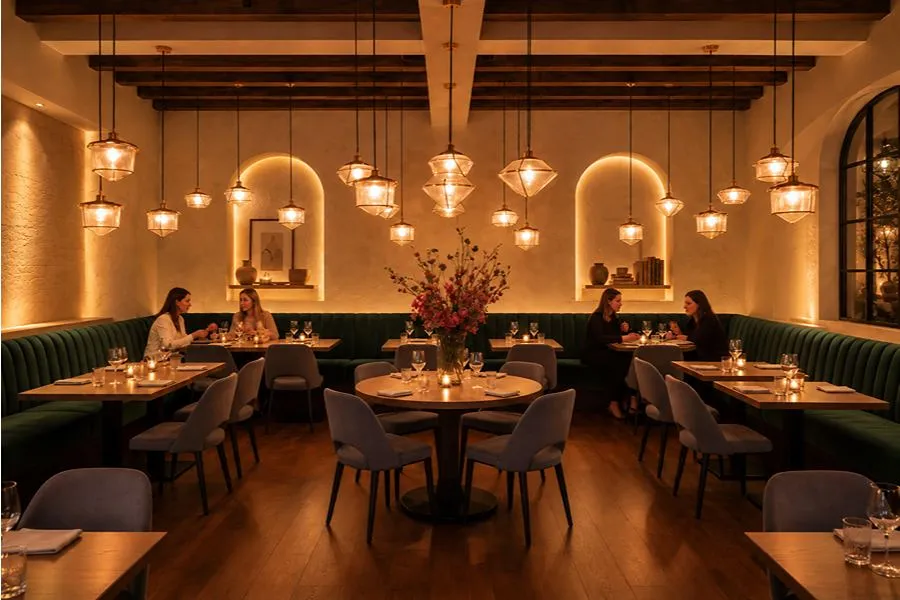
Restaurant Multi-Layer Lighting Application
2) Improve Table Lighting and the Dining Experience
Table lighting must enable patrons to view menus, food, and other people without exposing them to any direct light sources.
Chandeliers and pendant lights will be able to focus the light on the table, emphasizing food and plates as well as defining dining areas in an open main dining area.
3) Create a Decorative Focus and Strengthen Brand Identity
Chandeliers, custom pendants, and cluster lights can be used by you in creating focal points in the entrance area, reception area, main dining area, private dining area, and high ceiling area.
For branded hotels, branded restaurants, and fine dining establishments, it is possible for them to customize the shape, material, finish, and arrangement of the lighting fixtures.
4) Supplement Ambient, Task, and Accent Lighting
The lighting system in most restaurants is multi-layered. The ambient lighting serves as the base light source while task lighting assists menu items, tables, and cashier counters. Accent lighting is used for highlighting artwork, wine display, walls, and food display.
Pendants, chandeliers, and wall sconces could be used along with functional fixtures like downlights and spotlights in order to deal with decoration, table lighting, and feature lighting separately.
2. Common Decorative Lighting Fixture Types for Restaurants
The common decorative fixtures used in restaurants include pendants, chandeliers, wall sconces, table lamps, floor lamps, and decorative ceiling lights, which are explained below:
1) Pendant Lights
The most common use of pendant lighting fixtures is over dining tables, counter tops of bars, booths, and reception stands. The different kinds of arrangements include single pendants, linear pendants, and multiple pendants.
Single pendants are best suited for a smaller table space or localized space, linear pendants are perfect for long tables or bars, whereas multiple pendants can be fixed along a long table, bar, or reception area.
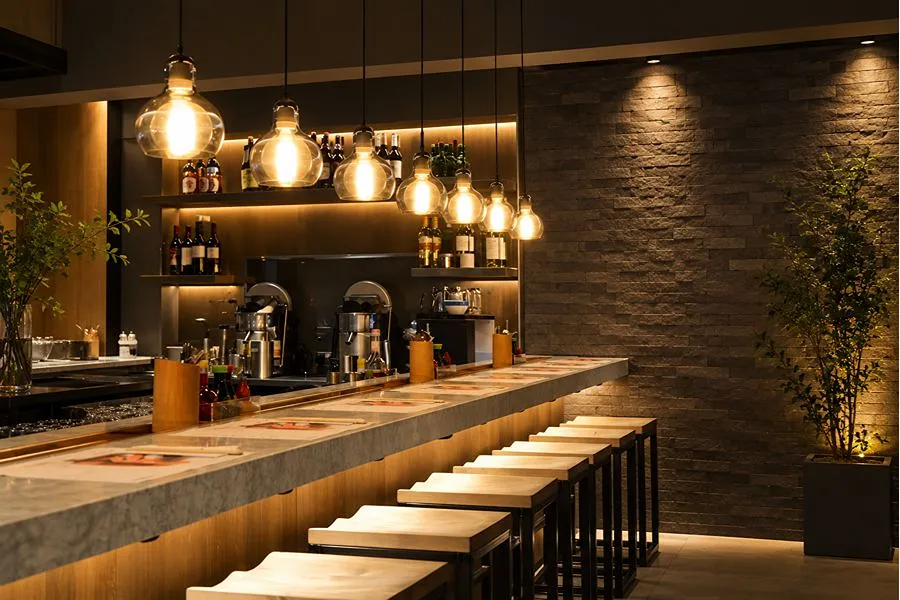
Pendant Lights over a Dining Table
2) Chandeliers
A chandelier is usually placed in main dining spaces, private dining rooms, entrance ways, and spaces having high ceilings. Common types include multi-arm, multi-tiered, linear, and custom-designed large chandeliers.
Compared to standard pendants, chandeliers are generally larger in physical size and in terms of visual bulk. Thus, they are better suited when there needs to be some decorative emphasis created within a space. Multi-tiered chandeliers or vertically elongated chandeliers will help add visual mass to the ceiling height.
3) Wall Sconces
The wall sconces are commonly used in locations such as near the booths where people sit, private rooms, corridors, feature walls, and art works. The sconces light up the walls without using any floor space or tabletop space.
Depending upon the design of these lights, they can provide uplighting, downlighting, up and downlighting, or diffused lighting on walls, art works, or seating areas.
4) Table Lamps and Cordless Table Lamps
Table lamps are commonly used on dining tables, bars, side tables, and lounges in order to provide lighting around the tabletop area.
Cordless table lamps are powered by rechargeable batteries and do not require a power cord to be run to each table. They are perfect for restaurants that regularly change table arrangements.
They are usually compact and provide multiple brightness settings allowing the light level at the table to be adjusted to suit dinner, bar service, or late night scenes.
5) Floor Lamps
Floor lamps are common in lounges, waiting areas, sofas seating and in other relaxing environments. The common floor lamps include the standard, arc and reading floor lamps.
The positioning of these lamps is flexible depending on the positioning of the furniture and thus they work best when there is the need for local lighting around sofas and lounging areas.
6) Decorative Ceiling Lights
The decorative ceiling lights that are available are largely classified into two types, namely, a flush mounted ceiling light or a semi flush mounted ceiling light. They are ideal for use in the restaurant spaces and areas with low overhead, where long pendant drops aren’t feasible.
These fixtures are mounted near the ceiling to save the space underneath, and can feature glass, metal, crystal and other materials to provide a decorative element.
3. How to Configure Light Color and Lighting Performance for Restaurant Decorative Lighting
The decorative lighting of a restaurant needs to be controlled in terms of light color, color rendering, glare and brightness during various meal times. These requirements can be set in four ways: CCT, CRI, glare control, and dimming:
1) CCT and Restaurant Atmosphere
The light in restaurants is usually warm, with a color temperature of 2700-3000K. For fine dining, wine bars, or those areas that focus on a more cozy vibe, a 2700K level can be tested first. Rooms that require to have food and interiors appear clearer, such as modern restaurants, hotel restaurants, and those wishing to create a cleaner appearance can start at 3000K.
There may be visual differences in the color of LED lights despite having the same nominal CCT. Turn on the lighting devices (pendant, wall lights, down lights among others) all at once and illuminate them all on the same white wall, table top and material samples in the sample stage. In case there are any evident green, pink and yellow hues between the lighting devices, the LED light source(s) or batch must be adjusted before mass production.
2) CRI, R9, and Food Color Rendering
Where the colour rendering demands are greater, like the main dining area, private dining room and food display, light sources with CRI ≥90 can be prioritised. Restaurants that feature a large variety of red-coloured foods, including steak, ham, tomatoes and red wine should also opt for R9. For areas where strong red rendering is required, R9 ≥50 may be used as a selection reference and subsequently verified with physical samples.
When approving samples, light up red meat, green vegetables, white plates, wood finishes and fabric samples with the candidate fixtures. Check whether red foods look gray, white objects show green or pink shifts, and skin tones appear natural.
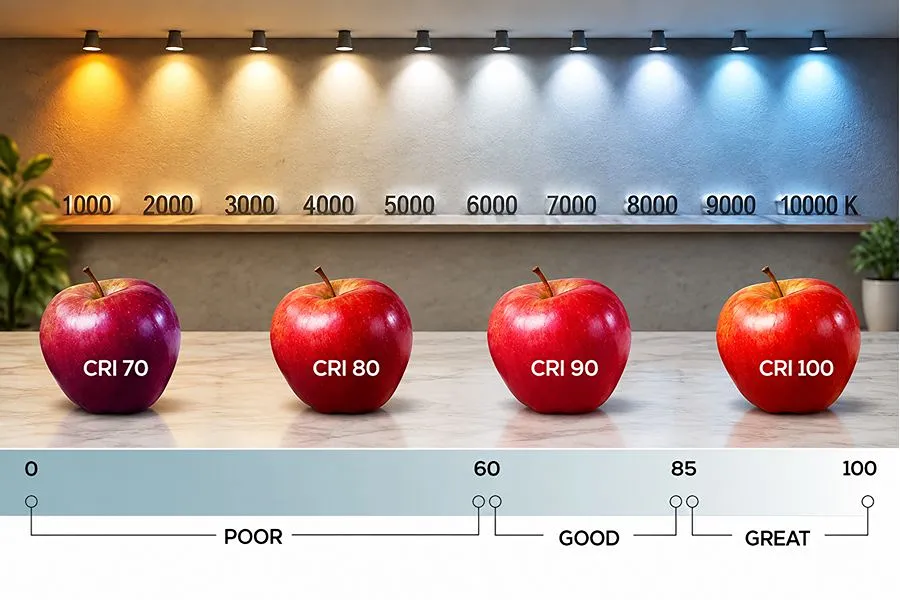
Food Lighting and Light-Quality Test
3) Glare Control and Visual Comfort
Restaurants are susceptible to common sources of glare such as low-hanging pendants, clear glass, exposed lamps, shallow shades, and high-output LED point sources. Where a UGR evaluation is required for a restaurant project, UGR ≤22 can be used as a reference level for some dining and public areas. Where stricter glare control is required, UGR ≤19 can be used as a design target.
After completing the sample/mock up, conduct the glare tests from the following positions: Dining Seat, Booth Seat, Main Walkway. In case the high intensity LED or open bulb can be viewed from the normal seating position, increase the depth of the shade, insert the light further in the shade, install an opal/frosted diffuser, or change the height and direction of the beam.
4) Dimming and Lighting Scenes
For restaurants, different light levels can be set for Lunch, Dinner, Late Night / Bar and Cleaning.
Maintain higher ambient light during lunch time. For dinner, reduce the ambient lighting while maintaining focused lighting on the tables. If you need to operate late, lower the background light levels even more. Increase functional lighting for cleaning to allow staff to effectively clean and inspect the space.
Test final LED source + driver + dimmer/control system combination from 100% to the minimum output value prior to mass production. If the dinner scene has to be dimmed steadily to 10%, for instance, then it should be turned on at 10% during the testing period and checked for any flicker, sudden shutdown, dis-synchronized dimming between fixtures, or inability of the system to maintain the minimum level steadily.
4. How to Configure Decorative Lighting for Different Restaurant Areas
The requirements of the fixture type, mounting position and lighting effect are varied according to the various areas of restaurant. Decorative fixtures should be designed based on the intended uses of the entry, main dining, private dining room, bar counter, booth seating, food display and lounge.
1) Entrance and Reception
Entrances and reception areas can make use of a statement chandelier, cluster pendant, or large decorative pendant to create a visual focal point.
In concept design, the following sizing formula can be used for a quick comparison of fixture size in a typical entrance: Room Length (ft) + Room Width (ft) ≈ Fixture Diameter (in). For instance, for a 12 × 16 ft entrance, 12 + 16 = 28, thus, a fixture with a diameter of about 28 in (710 mm) can be compared first and then adjusted based on ceiling height, fixture density, and visual mass.
For entrance ceiling heights of 4-5 m and higher, multi-tiered chandeliers or cluster pendants can be applied to enhance fixture verticality.
2) Main Dining Area and Dining Tables
Position fixtures relative to furniture layout and table positions in main eating area.
The width of a pendant or chandelier over a dining table can be approximately 1/2-2/3 of the table width and the length of a linear pendant can begin at approximately 1/2-2/3 of the table length as a starting point. The lowest point on the fixture is typically 750 to 900 mm above the table top, and then adjusted based on the fixture size, visible light sources and seated visionlines.
The initial design reference can be used as a tabletop illuminance of approximately 150-300 lx. Lower levels may be used in fine-dining or low-light restaurants, based on a mock-up.
While testing, place the lux meter on a tabletop, and find the dining position to observe the menu, plates, and the opposite guest’s face. If the fixture obstructs the view adjust the fixture height. The tabletop must be sufficiently illuminated if it is too dark, either by changing the beam angle or by adding a downlight.
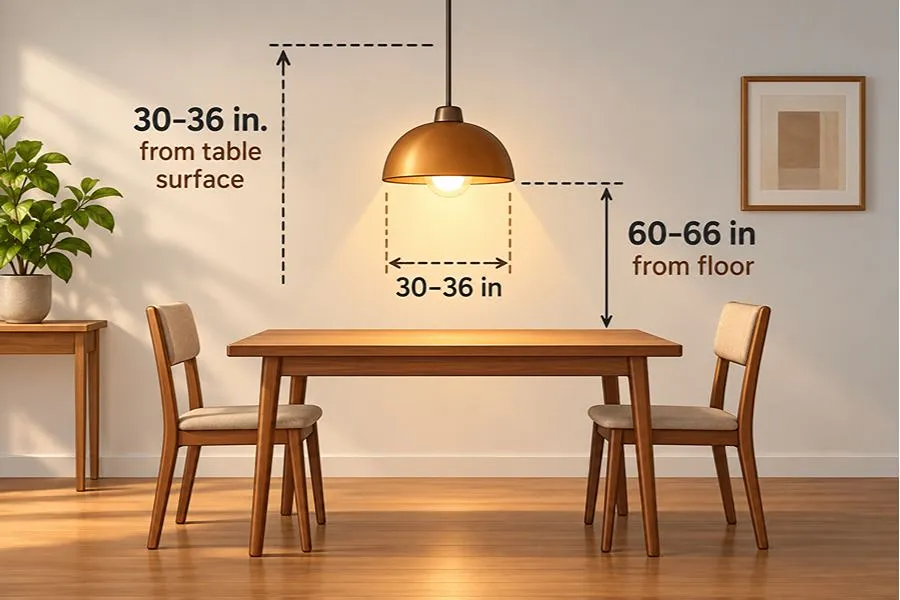
Dining Table Pendant Installation Relationship
3) Private Dining Room
Central Chandelier / Pendant + Wall Sconce + Architectural Downlight combination can be used in the private dining room. The central fixture provides the decorative feature above the table, wall sconces add depth to the walls and downlights help to illuminate tabletop areas.
Under the dinner scene, look at the amount of light at the end and middle of the table, one at a time. Add or re-position lighting points if the ends are discernibly darker.
4) Bar Counter
Bar counter lighting should highlight both the counter and beverage display while preventing fixtures from blocking sightlines between guests and the bartender. Linear pendants or repeated small pendants are therefore commonly used and arranged according to Counter Length + Seating Position.
For example, with three pendants over a 3000 mm bar, first define the center position of the two end fixtures relative to each end of the counter. Then calculate the center-to-center spacing of the middle fixture and dimension it directly on the shop drawing.
A pendant bottom height of about 750–900 mm above the counter surface can be used as an initial test range, then adjusted for fixture size and the sightline between guests and the bartender.
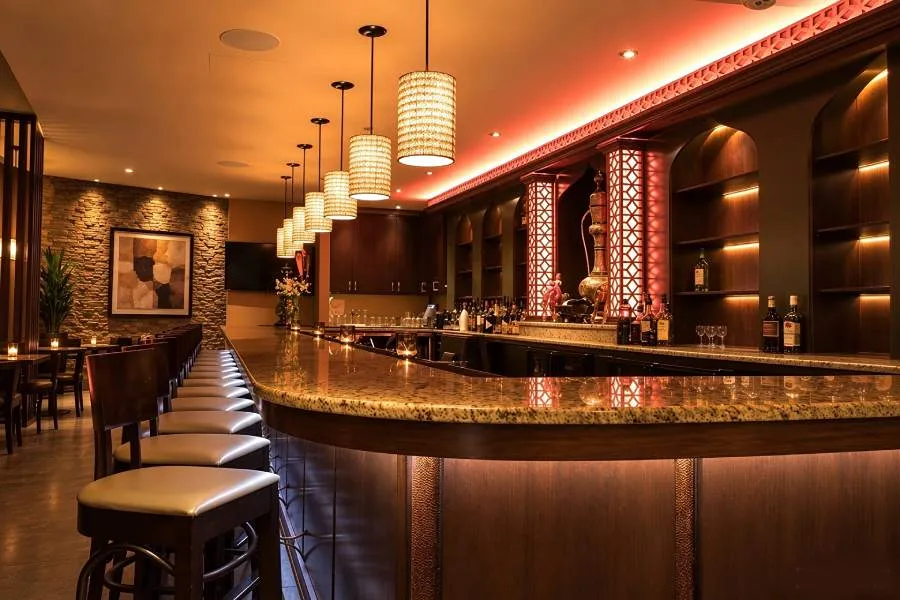
Bar Counter Pendant Arrangement
5) Booth Seating
Wall sconces, mini pendants and cordless table lamps are typical options for booth seating. Fixtures can be installed from the seat centerline and/or table centerline due to the fixed nature of the seats and tables.
When using wall sconces, refer to seated eye level and fixture projection. When choosing pendants make sure that people are not going to strike the pendant when standing. If you’re using cordless table lamps, make sure to see how much area they take up on the tabletop.
When mocking up, set the plates, wine glasses, condiments and table lamp in the center of the tabletop. If the base needs to occupy too much area on the serving tray, decrease the base diameter.
6) Buffet and Food Display Area
In food display and buffet situations, the most important consideration is to keep food color and presentation accurate, so that guests can view and choose the food. Spotlights or downlights can illuminate the area of the food display; decorative pendants can set the scene.
An initial design reference of ~300-500 lx at the surface of the food displayed may serve as a starting point, and then modified according to the overall light level, type of food displayed, and the way the food is displayed in the restaurant.
Do actual food sample tests for red meat, fruit and desserts. Look to see if there are any color casts in the reds, yellowing in the greens, or yellowing in the white plates.
7) Lounge and Waiting Area
Waiting and lounge areas have a greater need for localized and softer light sources and do not have to adhere to the tabletop approach of lighting in the main dining area. Floor lamps, table lamps, wall sconces, or lower output decorative pendants can be used as localized light sources surrounding the sofa, lounge, and side tables.
The floor lamp can be located either next to or just behind a sofa and lounge. The base and power cord should be shown on the furniture plan. Base location should be outside the pull zone and the power cord out of the path of guests.
5. Summary
Decorative lighting for restaurants should be planned in accordance with the type of restaurant, spatial location and the actual lighting effect of the fixture. Different dining areas can be fitted with pendants, chandeliers, wall sconces, table lamps or floor lamps and each of these has a direct impact on the way the food is presented and the experience of the dining area. CCT, CRI, glare and dimming have a direct impact on the food presentation, dining experience.
Postmodern Lighting can help advance a restaurant/hospitality project from fixture selection to actual production by offering standard products as well as custom decorative fixtures that meet the needs of the specific space, design drawings and fixture specifications.
