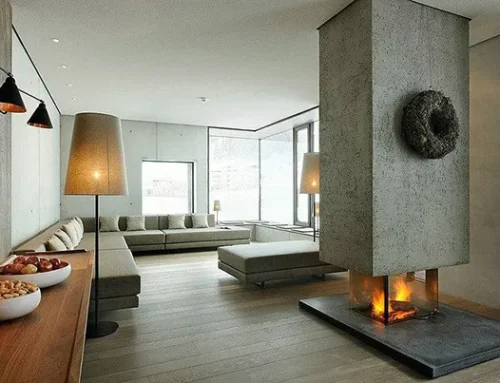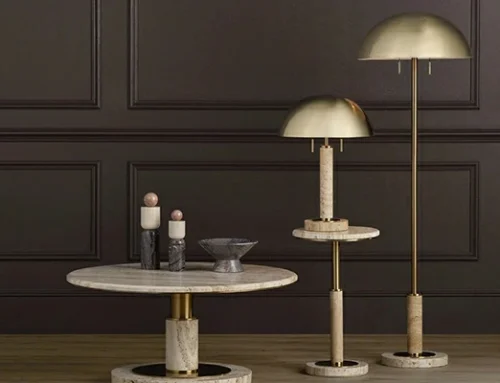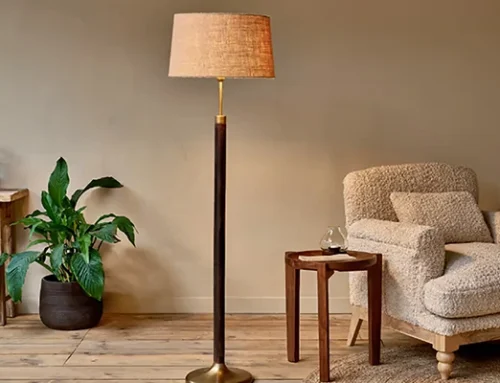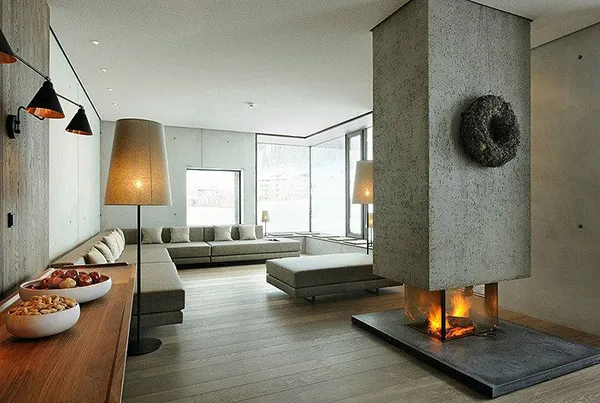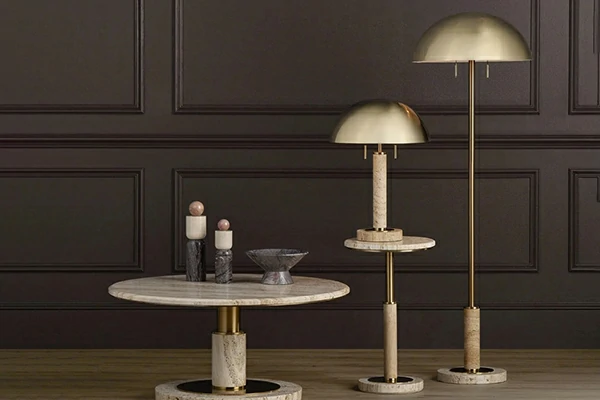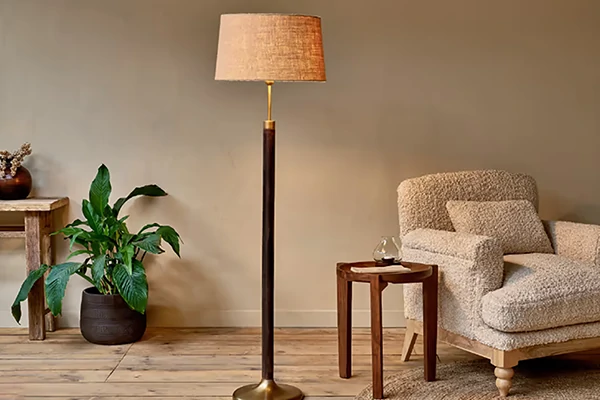
Floor lamps can be used to create ambient, reading and decorative lighting in hotel guest rooms, entertainment spaces, lobbies, apartments, restaurant lounges and commercial seating areas with flexibilities around sofas, lounges, bedsides and seating arrangements.
Based on Postmodern Lighting’s experience in hotel, apartment and commercial decorative lighting projects, this guide includes information on the common types of floor lamps, the main uses of floor lamps, where floor lamps are used, typical materials available for floor lamps, and key parameters to confirm when selecting floor lamps to help you to select and configure floor lamps more effectively for your project.
1. What Is a Floor Lamp?
When learning about lamps, it is important to begin with the foundation and basic parts of a lamp:
1) Definition of a Floor Lamp
Freestanding lamp placed directly on the floor; a floor lamp. It stands on its own base and its height is normally much higher than a table lamp.
2) Basic Structure of a Floor Lamp
A typical floor lamp mainly consists of the following components:
- Base: the part that holds up the fixture and impacts stability. The bottom is usually weighted with steel plate, cast iron, marble, stone, or otherwise to provide more weight to the bottom.
- Stem / Frame: Connects base to light – determines basic fixture height and shape.
- Arm: Common on arc and reading lamps, adjustable floor lamps, used for positioning the light head.
- Shade / Diffuser: Regulates light direction, diffusion and visibility of the light source.
- Light Source: Replaceable bulb E26 / E27, or integrated LED.
- Switch / Dimmer: Commonly installed on the stem, lamp holder, or power cord.
- Power Cord & Plug: Set power cord length and plug type based on installation site and market.
The floor lamp normally has a vertical stem, an arc floor lamp has an arm that projects outwards from the lamp, and a tripod floor lamp has three legs for stability.
2. What Are the Main Types of Floor Lamps?
On the basis of the design of fixtures, light distribution, and function, floor lamps can be classified into a number of types.
1) Standard Floor Lamp
The construction of a typical standard floor lamp comprises Base+ Vertical Stem +Shade, and its total height ranges from 1500–1800 mm. The most common installation spots for floor lamps are sofas, lounge chairs, beside beds and in corners of rooms. There are various materials used for shades: fabric, glass and metal. Fabric shade or opal glass shade produce diffuse ambient light, downward facing shade is better for concentrated local light.
2) Arc Floor Lamp
The arc lamp uses a curved or extended arm to project the light source outward from the base. This lamp base could be placed beside a sofa, lampshade may cover a sofa, lounge chair or coffee table, providing illumination and saving space before the seating.
3) Torchiere Floor Lamp
In a torchiere lamp, light is reflected from the ceiling and walls to provide an indirect / uplighting.
4) Reading / Task Floor Lamp
A reading / task floor lamp is used for local illumination in the area surrounding the books, desks, sofas and reading chairs.
Installing a smaller shade, directional light head or adjustable arm are usually the fixtures used. Light head must provide lighting to the reading area but must not allow high-brightness sources to be in the normal seated line of sight.
5) Tripod Floor Lamp
Tripod floor lamps feature three wide legs to provide stability and make the lamp look more furniture-like. The tripod design is more open visually than a standard floor lamp that has a single round base.
6) Multi-Light Floor Lamp
Multi-light floor lamp refers to a lamp that has multiple light heads. Some models allow for the independent adjusting of each head for angle and direction. The heads can be directed to a sofa, reading chair, wall, or other spaces where they will provide ambient and directional light.
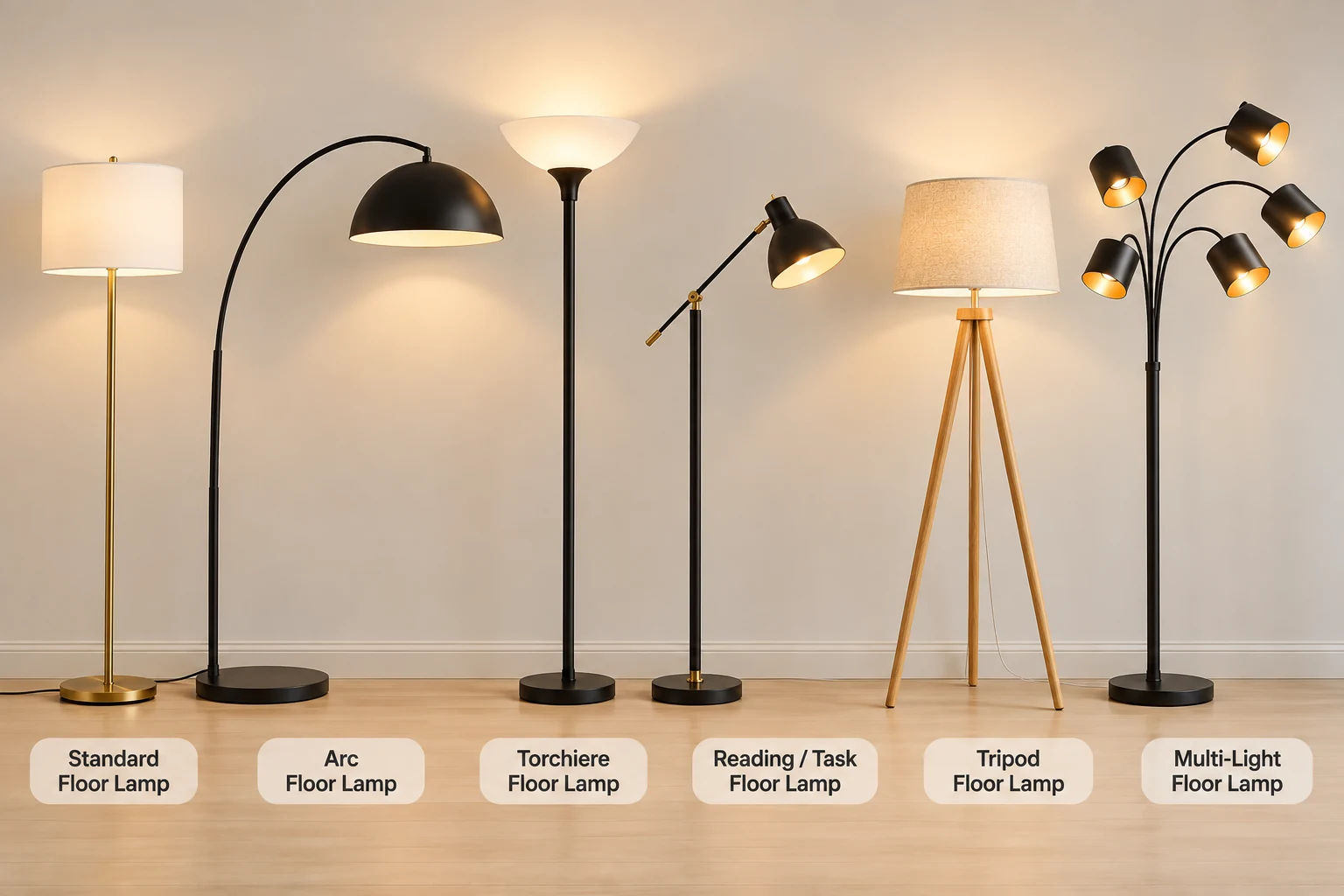
Common Floor Lamp Types
3. Main Lighting Functions of Floor Lamps
Lamp types can offer ambient, reading and indirect lighting, and also decorative lighting, through various light distributions. They serve the following main purposes:
1) Ambient Lighting
The ambient light fixture uses a shade of fabric and opal glass or diffuser for scattering the light around the source.
Typical places of application include guestrooms, suites, hotel lobbies, and living rooms at home. Ambient light fixtures can be used in conjunction with ceiling lights, down lights, and wall lights in corners of the rooms, beside sofas and lounge seating areas with the help of floor lamps.
2) Reading & Task Lighting
Reading lamps are primarily used when close to books, desks, reading chairs or sofas to direct light to a reading or local work surface.
Reading / task lighting – usually has a more defined light distribution pattern and can be made to illuminate a specific area by the use of a light head that moves directionally or by an extendable arm.
3) Indirect / Uplighting
Indirect lighting/uplighting throws light upwards onto the ceiling or walls and works by surface reflection to produce soft indirect light. The torchiere floor lamp is one of its examples. The light source usually faces upwards, minimizing direct light in the line of vision but producing bright ambient light.
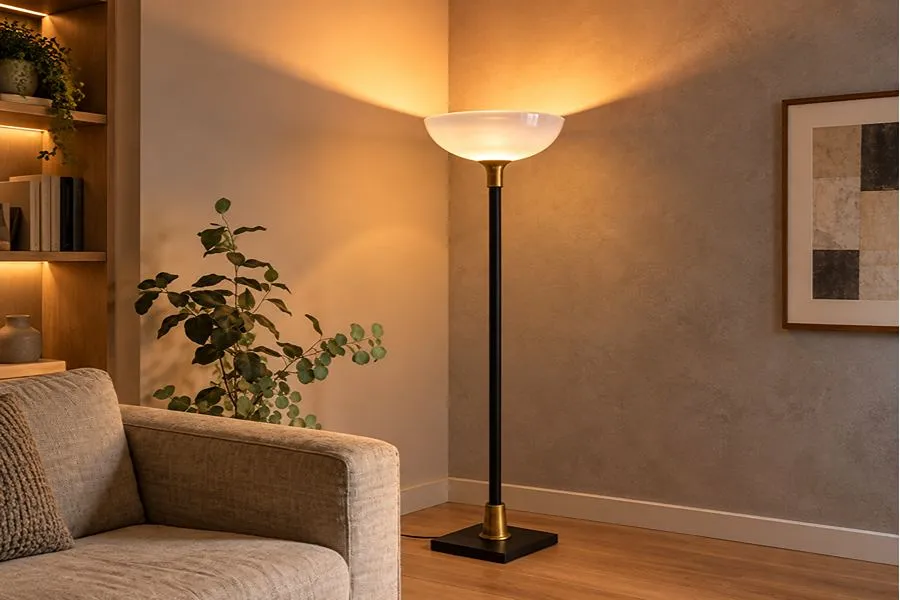
Indirect Lighting Effect of a Torchiere
4) Accent & Decorative Lighting
Accent lighting is to illuminate specific pieces of artwork, feature walls or specific areas of a space.
When it comes to a decorative light, the focus is taken on the appearance of the floor lamp itself. The form, material, proportion and light and shadow effects can all make the fixture a decorative element and also supply local lighting while adding depth to the space.
4. Floor Lamp Applications in Hotels, Apartments, and Commercial Spaces
The placement of lamps will depend on the type of furniture, the needed use and circulation spaces. A few of the most popular applications in hotels, apartments and commercial buildings are listed below.
1) Hotel Guestroom & Suite
Floor lamps are used in hotel guest rooms near sofas, lounge chairs, desks or in corner areas of rooms.
Use an ambient floor lamp in a room corner and a reading floor lamp near a lounge chair. The placement of fixtures should also align with the outlet positions.
2) Hotel Lobby & Lounge
In the lobby or lounge of a hotel these floor lamps are typically grouped together with a couple of seating chairs, coffee table and side table.
A standard floor lamp will work next to a sofa, an arc lamp will extend its light head over a seat or coffee table, and a decorative floor lamp can be used on both sides of a group of seating spaces or in a corner of the room. Determine fixtures based on furniture placement and don’t install fixtures on main traffic corridors.
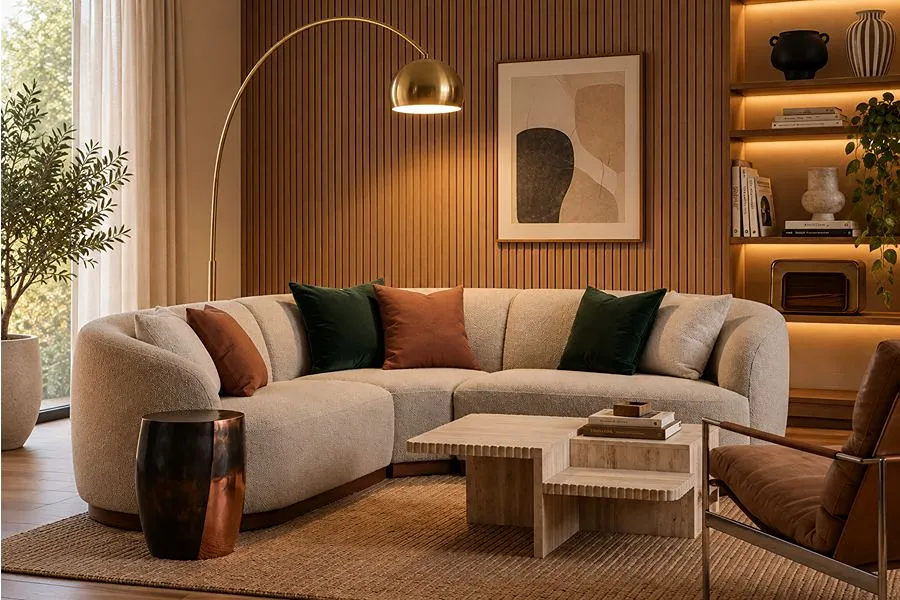
Arc Floor Lamp and Furniture Layout
3) Serviced Apartment & Residential Project
Depending on the functional area, there are various types of floor lamps that can be used in serviced apartments or residential projects.
Standard floor lamp can provide ambience lighting for the living room, reading floor lamp for the sofa or reading chair, arc floor lamp for coffee table or seating area, and arc torchiere for indirect lighting. In case the furniture can be moved, provide outlets in locations where furniture like sofas, lounge chair, and even room corners will be located.
4) Restaurant & Bar Lounge
Fixed lounge, waiting spaces and sofa seating in restaurants and bars are typical applications for floor lamps. Locate fixtures to the side or slightly behind sofas, and use ambient lighting with fabric shades, opal glass or other diffusers to produce a low amount of ambient light.
5) Reception & Waiting Area
Use floor lamps around a sofa, lounge chair and side table in reception area and waiting areas. Use standard floor lamps in smaller spaces; arc or decorative floor lamps in larger waiting lounges; and reading floor lamps where a reading area is provided. Place fixtures to avoid primary circulation paths and to position with seating groups.
5. Common Floor Lamp Materials
Floor lamps can use metal, stone, glass, fabric, wood, and other materials. Each material differs in structural strength, weight, light transmission, and decorative appearance. Common options include the following.
1) Steel, Brass & Aluminum
Steel has a good strength and stiffness. It’s generally used for stems, arms, frames and more for internal base structures, as well as for slim lamp poles and larger fixture bodies.
Brass is a resistant metal that gives a good metallic look and aesthetic value. It may be finished with a polished, brushed, antique or other treatment and is used for stems, frames and decorative parts of floor lamps for decoration.
Aluminum has a light weight, is easy to process and offers a high thermal conductivity. It is widely utilized for shades, light heads, or bodies/parts of the integrated LED floor lamps and other applications needing extra heat dissipation.
2) Marble, Stone & Concrete
Marble is naturally veined, it exhibits high density and has a good decorative value. It offers a natural stone looking appearance with added weight to the base of the floor lamp making it used on decorative and luxury floor lamps.
Natural stones like travertine and granite also are excellent for weight and natural texture. Granite tends to be heavier and harder wearing, whereas travertine has more apparent natural pores and texture, and would work well for various decorative floor lamp bases.
Concrete is dense and can be formed in various sizes and forms. Its natural surface finish is a favourite base for contemporary, minimalist and industrial floor lamps.
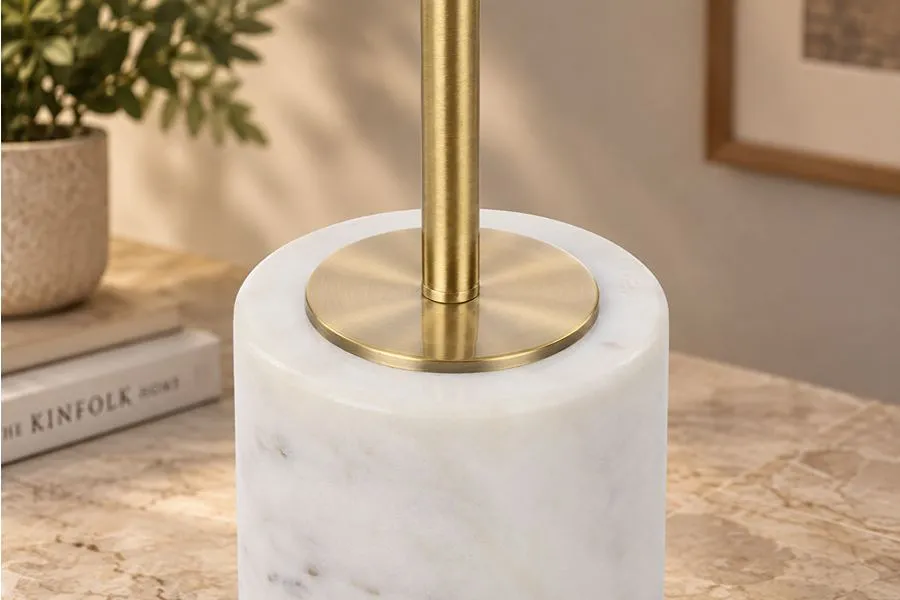
Marble + Brass
3) Glass & Crystal
Clear glass has good transparency and keeps the light source and internal structure visible. It is used for globes, shades and various decorative items.
Frosted glass will spread light around its interior and minimize the glare of light bulbs from the outside, ideal for floor lamp shades that need softer light.
The opal glass offers higher diffusion and shielding, and limits the direct visibility of LED point sources. It’s standard to use it on integrated LED or ambient floor lamps for diffusers and shades.
Textured glass is a form of glass that is treated with a pattern or texture to create a change in the way the glass refracts light, while also providing a decorative effect to the glass. It is usually used in decorative floor lamps.
Colored glass is glass that has been colored, and it is primarily used for decorative shades, globes and other decorative applications and it keeps the glass light transmitting property.
The transparency of crystal is high and the refraction is strong. If the surfaces need to be cut, the effect of light and shadow is exaggerated and the sparkle is greater, so crystal is primarily used for decorative elements of luxury and decorative floor lamps.
4) Fabric, Rattan, Wood & Other Materials
Fabric is soft and will let light pass through. Light transmission can also be regulated by varying the density of the fabrics and liners. Typically they are made from linen, cotton, or polyester, primarily for ambient and hotel floor lamps.
Rattan is light and it is woven which permits light to get through and generate natural lighting and darkness effects. It is frequently used as shades for natural style and resort/hospitality floor lamps.
Woods are warm, natural products that offer a visual texture. It is used for stems, frames or decorative parts and is often found on floor lamps designed for home, nature and Scandinavian themes.
Acrylic is light in weight, formable and has good light transmission. Can be formed into diffusers that are curved and irregular, and is frequently found on modern and integrated LED floor lamps.
Resin can be easily molded into complex shapes and can imitate stone, wood and other effects. It is thus primarily employed in complex bases, frames and decorations.
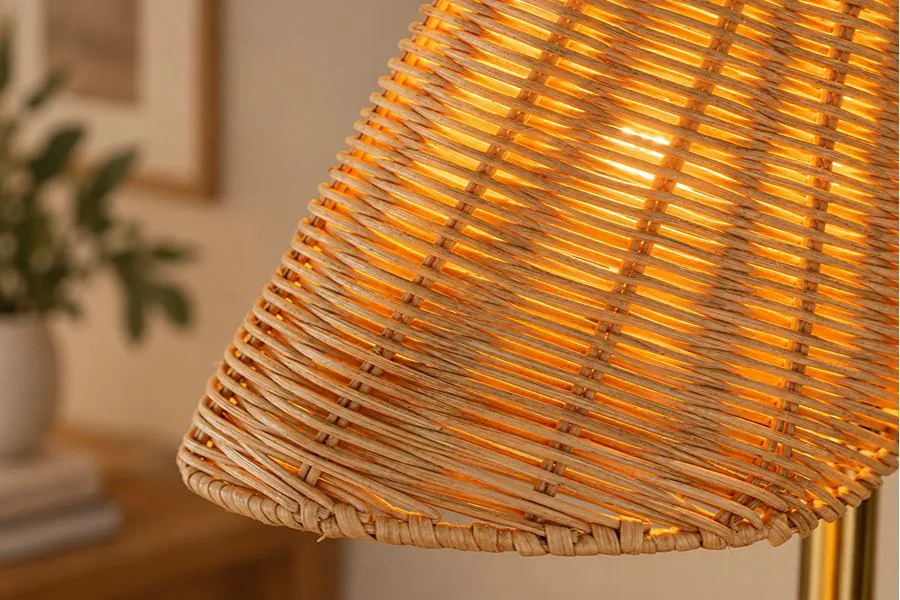
Rattan Material
6. Key Parameters to Confirm When Selecting a Floor Lamp
Consider size, light source, plug-in, dimming and future maintenance requirements when selecting a floor lamp. These are some of the things that should be emphasized when selecting a project:
1) Overall Dimensions, Footprint & Stability
- Standard floor lamp: Overall height + maximum width + base dimensions
- Arc floor lamp: Also record maximum reach / arm length
- Tripod floor lamp: Also record the maximum width × depth with all three legs fully spread
- Multi-light floor lamp: Record the maximum width × depth with all light heads fully extended
- Stability: Test arc, adjustable, and multi-light floor lamps under the most unfavorable operating condition using a Stability / Tip-Over Test—for example, with the arm at maximum extension, the light head at maximum outward position, or the adjustable stem at maximum height. Revalidate stability whenever arm length, shade weight, fixture height, or base construction changes.
2) Light Source & Light Output
- Replaceable bulb: E26 / E27 lamp holders are commonly used. Confirm maximum wattage, bulb type, and lumens.
- Integrated LED: Confirm rated wattage, lumens, efficacy (lm/W), LED module, and driver. For directional products, also confirm beam angle.
- Ambient floor lamp: Focus on lumen output and light diffusion.
- Reading / task floor lamp: Confirm lumens, beam angle / light direction, and work-plane illuminance. A reference illuminance of 300–500 lx can be used for reading areas.
3) CCT & CRI
For hotel and commercial projects, common floor lamp CCT reference ranges include:
- Hotel guestroom / suite: 2700–3000K
- Restaurant / bar lounge: 2700–3000K
- Lobby / reception: approximately 3000K
- CRI: For general decorative lighting, CRI ≥80 can be used as a starting point for selection. For hotel guestrooms, restaurants, reading areas, and spaces requiring more accurate rendering of interior finishes, prioritize CRI ≥90. Where better rendering of reds, skin tones, and food colors is required, also confirm R9; R9 ≥50 can be used as one project selection reference.
4) Switch Type & Switch Location
Common switch types include: rocker switch / push-button switch / foot switch / pull-chain switch / touch switch
- When using a reading lamp: Place the switch where it is easily accessible from a standard sitting position.
- Foot switch: Avoid placing it behind sofas, side tables or any other furniture.
- Multi-light floor lamp: Double-check if each head is independently controlled or all heads are put into service.
- Mock up room test: Position fixture based on end furniture placement, and ensure that the switch can be easily operated.
5) Plug, Voltage & Power Cord Length
- U.S. market: commonly 120V / 60Hz
- European market: commonly 220–240V / 50Hz
- Power cord length: For hotel and apartment projects, 2.0–2.5 m can be used as a configuration reference. If the outlet is not very close, or there are special requirements for the furniture layout, a cord length of about 3 m can be specified.
- Also check plug type, colour of power cord and direction of cord exit.
- All power cords, plugs, lamp holders, switches and drivers must comply with safety certification standards of the intended market. Verify UL / ETL requirements for U.S. projects, CE and applicable electrical safety requirements for EU projects.
6) Dimming & Control
Common dimming methods include rotary dimming / foot dimming / touch dimming / 0–10V / DALI / dimmable driver. If the project control protocol is to be interfaced with a hotel or commercial lighting control system, also check the compatibility of the drivers.
If the final LED module, driver, and dimmer/control system combination is used for integrated LED floor lamps, then test the combination for compatibility.
Slowly reduce the light from 100% to the required minimum value, and observe for flicker, sudden shutdown, brightness jumps and minimum stable light level.
7) Replaceable Parts & Maintenance
Common replaceable parts include: shade / diffuser / bulb / LED module / driver / switch / power cord / plug / lamp holder
- Replaceable bulb: Standard lamp holders (E26 / E27) may be used.
- Separate LED Module & Driver: The LED module and driver must be easily removable and replaceable.
- Large hotel / apartment projects: Develop a standard lamp holder, LED modules, and driver specification for a variety of floor lamp types to minimize the number of spares types.
- Spare parts list:Include replaceable parts like shades, diffusers, LED modules, LED drivers, and their respective part numbers.
7. Summary
Choose floor lamps based on the space, lighting purpose and the place where they are to be placed. There are several types of standard, arc, torchiere, reading, tripod and multi-light floor lamps that have different structures, light patterns and footprints that can be used in guestrooms, lobbies, apartments, restaurant lounges, reception areas and waiting areas in the hotel.
Postmodern Lighting can supply traditional or custom floor lamps, depending on the type of project (hotels, apartments, commercial) and the design drawings and fixture requirements. We can also confirm dimensions, light source, CCT, CRI, switches, plugs, power cords, dimming and replaceable parts, which will take the project from fixture selection to sample approval to mass production.