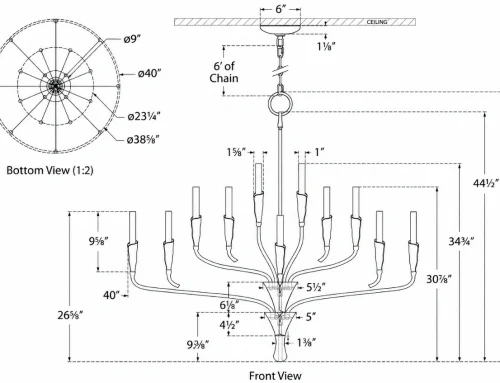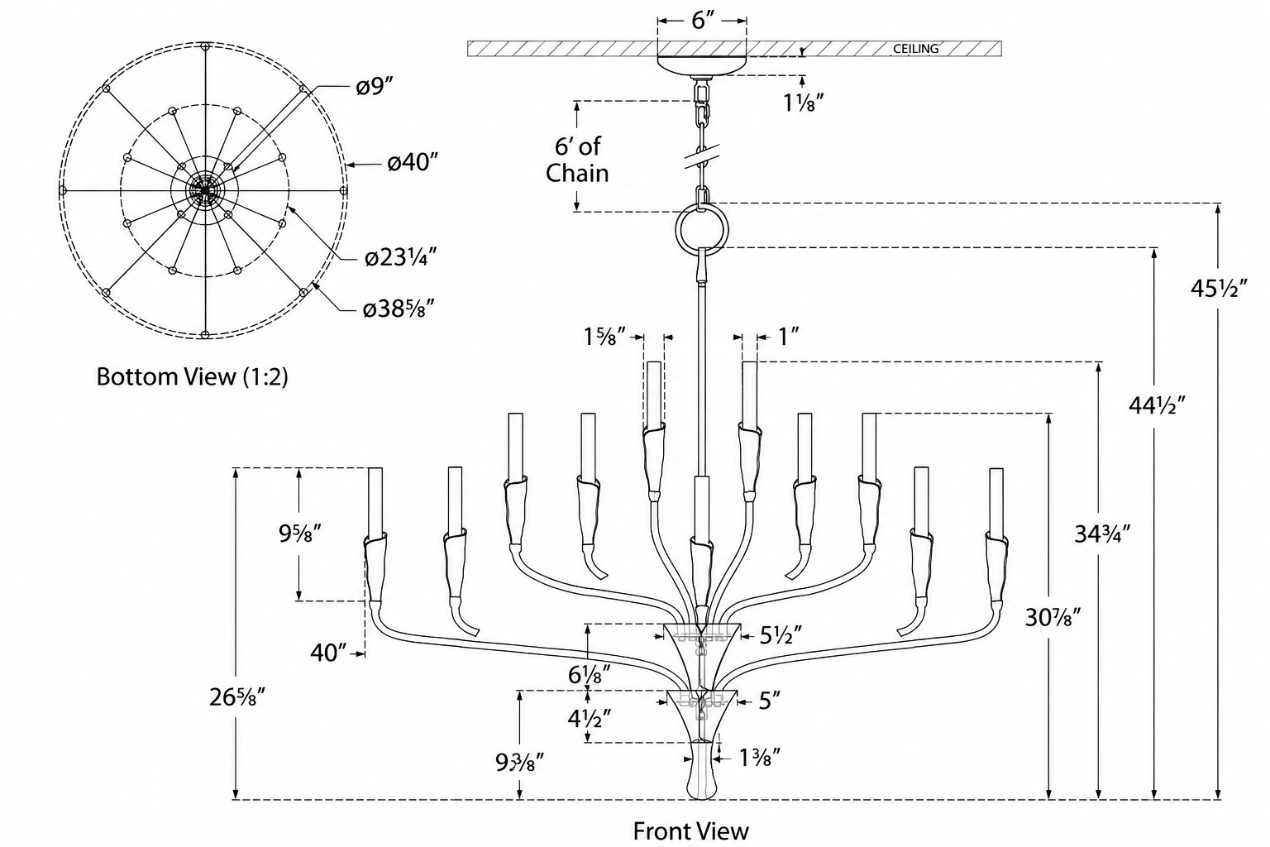
Decorative lighting is more than just a lighting fixture; it is an essential part of interior spaces. In hotels, restaurants, residences, villas, and commercial spaces, it not only provides illumination but also influences the atmosphere, visual hierarchy, and overall spatial experience.
Unlike general lighting, decorative lighting combines illumination with design aesthetics. The form, material, and structure of the fixture are just as important as the light it emits. From chandeliers and pendant lights to wall lights, table lamps, and floor lamps, different types of decorative lighting differ in installation methods, lighting performance, visual impact, and suitable applications.
This article focuses on the five most common types of decorative lighting, explaining their characteristics, common styles, typical applications, and key differences to help you gain a comprehensive understanding of their features and suitability.
1. What Is Decorative Lighting?
Decorative lighting refers to lighting fixtures that combine both functional illumination and decorative value.
When selecting decorative lighting, people consider not only how much light a fixture provides, but also its shape, materials, proportions, colors, and the visual effect it creates within a space.
Simply put, decorative lighting serves two primary purposes:
- Providing illumination
- Enhancing the visual appeal of a space
2. Common Characteristics of Decorative Lighting
Although decorative lighting includes a wide variety of products, they generally share several common characteristics.
First, decorative lighting has a strong decorative purpose. The appearance, proportions, materials, and design of the fixture itself are important aspects of its value.
Second, decorative lighting still performs a lighting function. Regardless of its appearance, every decorative light must ultimately satisfy the illumination requirements of a space.
Third, decorative lighting is available in a wide range of design styles. From modern, luxury, and industrial styles to Scandinavian, natural, and classic styles, almost every interior design style can be expressed through different decorative lighting designs.
Fourth, decorative lighting features different installation methods. Some fixtures are mounted directly on the ceiling, some are suspended from the ceiling, some are mounted on walls, some are placed on tables or other furniture surfaces, while others are freestanding on the floor.
Finally, decorative lighting often combines multiple materials. For example, metal frames paired with glass shades, wood combined with fabric shades, or crystal combined with brass structures. Different material combinations directly affect both the visual appearance of the fixture and the quality of light it produces.
3. Decorative Lighting Types Explained
This section explains the five main decorative lighting types from a product perspective, including their basic structure, common styles, materials, advantages, and limitations. By looking at each type separately, it becomes easier to understand why chandeliers, pendant lights, wall lights, table lamps, and floor lamps serve different roles in interior spaces.
In actual projects, decorative fixtures are rarely evaluated by appearance alone; their structure, mounting position, and lighting role usually determine where they are used.
1) Chandeliers
Among decorative lighting types, chandeliers are usually the most visually prominent ceiling-suspended fixtures.
a. What Is a Chandelier?
A chandelier is a decorative lighting fixture suspended from the ceiling, typically consisting of multiple light sources. With its large size and eye-catching design, it often serves as the visual focal point of a space. Depending on its structure, a chandelier may feature single-tier, multi-tier, ring-shaped, sputnik, or modular designs, resulting in a wide variety of sizes and appearances.
In practice, large lobby or stairwell projects often use chandeliers to establish the first visual impression of the space.
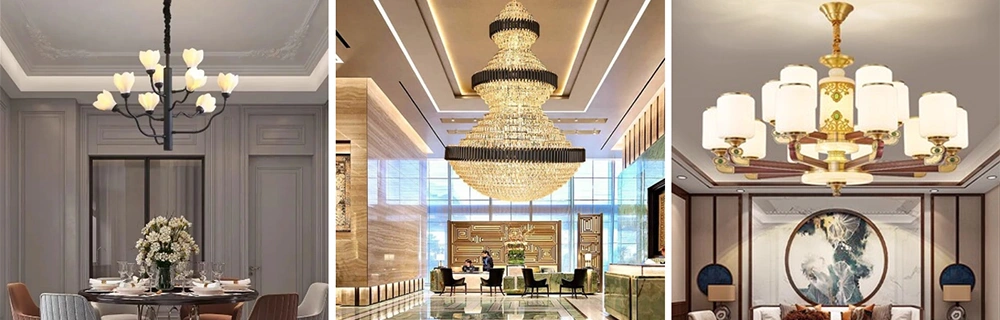
Chandelier Example
b. Common Types
- Crystal Chandeliers:Feature crystal or glass pendants that create rich light refraction effects, making them suitable for classic and luxury interiors.
- Modern Chandeliers:Characterized by clean lines and geometric forms, ideal for modern residential and commercial spaces.
- Ring Chandeliers:Designed with circular structures that deliver a contemporary appearance, commonly used in hotels and office spaces.
- Sputnik Chandeliers:Feature radiating arms extending from a central core, creating a distinctive sculptural look.
- Linear Chandeliers:Designed with a horizontal profile, making them suitable for long dining tables, conference tables, and kitchen islands.
Candle Chandeliers: Inspired by traditional candleholders, making them suitable for French, classic, and rustic interiors.
c. Common Materials
Common materials include crystal, glass, metal, brass, wood, and acrylic. Different materials not only determine the overall appearance of the fixture but also affect its weight, light transmission, and overall texture.
d. Advantages
- Creates a strong visual focal point.
- Provides wide lighting coverage.
- Available in a wide variety of styles and sizes.
- Suitable for residential, hospitality, and commercial applications.
e.Limitations
- Requires relatively high ceiling heights.
- Fixed installation position with limited flexibility after installation.
- Large or crystal chandeliers generally require higher maintenance.
- Places greater demands on the supporting structure. Large chandeliers typically require pre-installed or reinforced mounting brackets to ensure installation safety.
2) Pendant Lights
Compared with chandeliers, pendant lights feature a simpler structure and are primarily designed for localized lighting and visual layering.
a. What Is a Pendant Light?
A pendant light is a decorative lighting fixture suspended from the ceiling by a cord, rod, or chain. It typically uses a single light source or a small number of light sources to provide concentrated illumination, making it suitable for lighting dining tables, bar counters, kitchen islands, and other specific areas.
Pendant lights can be installed individually, in clusters, or in linear arrangements, and different layouts directly influence both the lighting coverage and the overall visual effect.
In restaurant, bar, and reception projects, pendant lights are often arranged in rows or clusters to define functional zones without making the ceiling appear visually heavy.
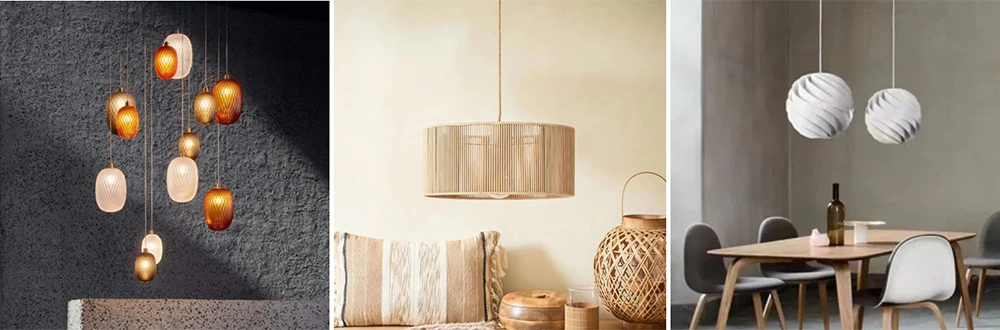
Pendant Light Example
a. Common Types
- Single Pendant:Suitable for localized lighting above dining tables, bedside areas, and bar counters.
- Cluster Pendant:Combines multiple pendants to create greater visual depth and layering.
- Linear Pendant:Features a horizontal design, making it ideal for long dining tables, conference tables, and kitchen islands.
- Glass Pendant:Uses glass shades to create a light, transparent appearance with soft illumination.
- Metal Pendant:Primarily constructed from metal, offering a modern appearance and excellent durability.
- Wood & Rattan Pendant:Made from natural materials to create a warm and organic atmosphere.
b. Common Materials
Common materials include glass, metal, wood, rattan, fabric, and acrylic. Different materials influence light transmission, texture, and overall style. For example, glass provides greater transparency, metal delivers a modern appearance, while wood and rattan emphasize a natural aesthetic.
c. Advantages
- Provides precise localized illumination.
- Flexible installation, suitable for both single and multiple configurations.
- Requires relatively lower ceiling heights.
- Available in a wide range of styles suitable for residential, hospitality, and commercial spaces.
d. Limitations
- Provides limited lighting coverage and is typically used together with other lighting fixtures.
- Installation height should be carefully adjusted to achieve the desired lighting effect.
- Multiple pendant installations require appropriate spacing and proportional arrangement.
- Voltage standards vary across different countries and regions. International projects often require fixtures compatible with local voltage specifications, such as 110V or 220–240V.
- LED pendant lights require consideration of driver placement. Integrated drivers offer a cleaner appearance, while external drivers simplify future maintenance and replacement.
3) Wall Lights
Unlike ceiling-suspended fixtures, wall lights use vertical surfaces to provide supplementary illumination and add visual depth to the space.
a. What Is a Wall Light?
A wall light is a decorative lighting fixture mounted directly on a wall. It provides supplementary illumination and decorative effects through upward, downward, or bidirectional light distribution. Wall lights can provide direct illumination or create indirect lighting by reflecting light off the wall, offering more versatile lighting effects than other decorative lighting fixtures.
In hotel corridors and guest rooms, this type of wall-level lighting is often used to soften the overall lighting environment and reduce reliance on overhead fixtures.
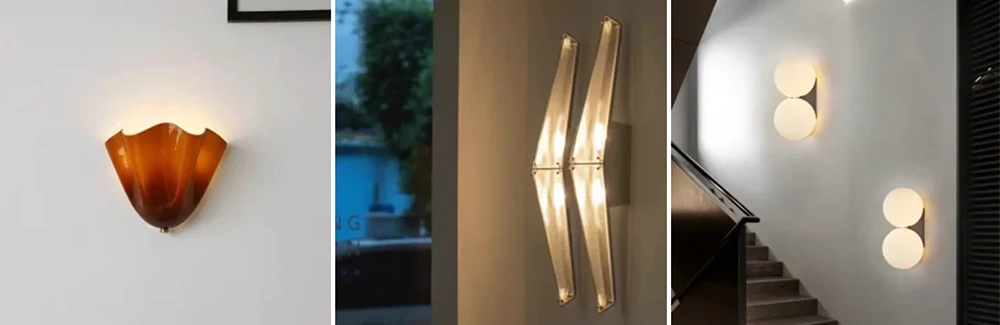
Wall Light Example
b. Common Types
- Decorative Wall Sconce:Combines illumination with decorative appeal, suitable for residential and commercial spaces.
- Up & Down Wall Light:Emits light both upward and downward to create balanced wall lighting effects.
- Reading Wall Light:Features an adjustable reading light, ideal for bedside and reading areas.
- Vanity Wall Light:Installed beside or above mirrors to provide even illumination.
- Picture Light:Designed to illuminate artwork, decorative paintings, or display walls.
c. Common Materials
Common materials include metal, glass, crystal, fabric, wood, marble, acrylic, and ceramic. Different materials affect the fixture’s texture, light transmission, and overall style, with metal and glass being one of the most common combinations.
d. Advantages
- Occupies neither ceiling space nor floor space.
- Produces soft illumination that enhances spatial layering.
- Ideal for narrow or space-limited areas.
- Combines decorative appeal with practical functionality.
e. Limitations
- Provides limited lighting coverage and is generally unsuitable as the primary lighting source.
- Fixed installation position offers limited flexibility after installation.
- Large spaces usually require wall lights to be used together with other lighting fixtures.
- Wall lights should be selected according to the project’s dimming system compatibility, such as DALI, 0–10V, or TRIAC d Otherwise, the intended lighting control performance may not be achieved.
- For integrated LED wall lights, the installation location of the drivershould be planned in advance to ensure sufficient installation space and convenient future maintenance.
4) Table Lamps
Unlike wall-mounted fixtures, table lamps work directly with furniture surfaces, making them a more flexible option for close-range decorative lighting.
a. What Is a Table Lamp?
A table lamp is a freestanding decorative lighting fixture placed on furniture surfaces such as bedside tables, desks, console tables, or side tables. Unlike floor lamps, it does not occupy floor space; unlike wall lights, it does not require wall installation. Its main value is to provide close-range lighting while visually completing the furniture setting.
In hotel guestrooms and residential interiors, table lamps are often used in pairs on bedside tables or placed on side tables to create a warmer, more intimate lighting layer.
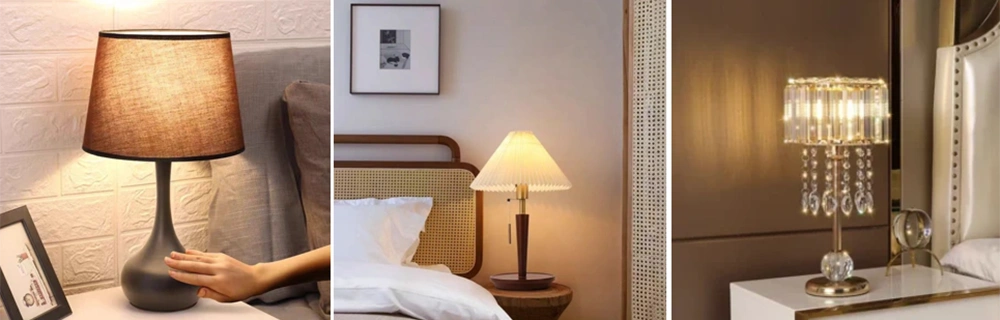
Table Lamp Example
b. Common Types
- Bedside Table Lamp: Designed for nightstands and hotel guestrooms, usually providing soft close-range lighting.
- Desk Lamp: Used on desks or work surfaces, often with a more focused light direction.
- Decorative Table Lamp: More focused on form, material, and visual style than strong illumination.
- Ceramic Table Lamp: Uses a ceramic body to add texture, color, and decorative value to furniture settings.
- Glass Table Lamp: Creates a lighter and more transparent visual effect, often used in modern or luxury interiors.
- Rechargeable Table Lamp: Cordless design, suitable for restaurants, cafés, and flexible table settings.
c. Common Materials
Common materials include ceramic, glass, metal, fabric, marble, wood, crystal, and acrylic. For table lamps, the material of the base affects stability and visual weight, while the lampshade material directly affects light diffusion, glare control, and the softness of the surrounding light.
d. Advantages
- Does not require fixed installation or wall wiring.
- Fits directly into furniture layouts such as bedside tables, desks, consoles, and side tables.
- Provides close-range lighting suitable for reading, bedside use, and soft ambient lighting.
- Easy to replace when the interior style or furniture arrangement changes.
e. Limitations
- Requires available tabletop space and may not suit very small bedside tables or narrow consoles.
- Lighting coverage is limited and mainly serves close-range or ambient lighting.
- Power outlet and switch positions should match the furniture layout.
- In hotel projects, table lamp size, shade height, plug type, and switch control should remain consistent across rooms.
5) Floor Lamps
Unlike fixed ceiling or wall-mounted fixtures, floor lamps provide decorative lighting that can be added, moved, or adjusted without changing the building structure.
a. What Is a Floor Lamp?
A floor lamp is a freestanding decorative lighting fixture that requires no fixed installation and can be repositioned according to the spatial layout. A floor lamp typically consists of a base, pole, and lampshade, with different structural designs influencing its stability, lighting direction, and visual appearance.
In hotel guest rooms, lounge areas, and model homes, floor lamps are often added as a flexible secondary light source without modifying the ceiling or wall layout.
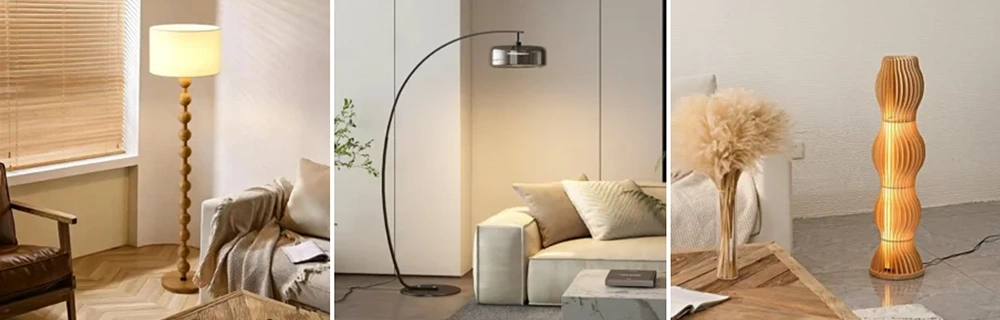
Floor Lamp Example
b. Common Types
- Arc Floor Lamp:Features a curved arm design, making it suitable for sofas and lounge areas.
- Tripod Floor Lamp:Uses a three-legged support structure, offering both stability and decorative appeal.
- Reading Floor Lamp:Provides focused illumination, making it suitable for reading and office use.
- Torchiere Floor Lamp:Directs light upward to create soft indirect illumination through ceiling reflection.
- Decorative Sculptural Floor Lamp:Features distinctive artistic forms that enhance the decorative character of a space.
c. Common Materials
Common materials include metal, wood, glass, fabric, marble, acrylic, and rattan. Different materials influence the fixture’s texture, stability, and overall style. Among modern floor lamps, metal, marble, and glass are the most commonly used material combinations.
d. Advantages
- Requires no fixed installation and can be easily repositioned.
- Quickly adds localized lighting where needed.
- Enhances spatial layering and atmosphere.
- Available in a wide variety of styles that combine decorative appeal with practical functionality.
e. Limitations
- Occupies floor space, making it unsuitable for narrow walkways, high-traffic areas, or small rooms.
- Provides localized illumination and generally cannot replace primary lighting such as chandeliers or ceiling lights.
- Power cord routing should be carefully considered, especially in public spaces where cable management may affect both aesthetics and safety.
- Tall, arched, or oversized floor lamps place greater demands on base stability. An insufficiently weighted base may increase the risk of tipping over.
4. Why Are There So Many Types of Decorative Lighting?
The wide variety of decorative lighting fixtures and their clearly defined categories are not simply the result of design differences. In real hospitality and commercial projects, fixture types are usually determined by installation conditions, lighting purposes, space scale, and how people move through the space. There is no absolute superiority among different fixture types—only differences in application suitability.
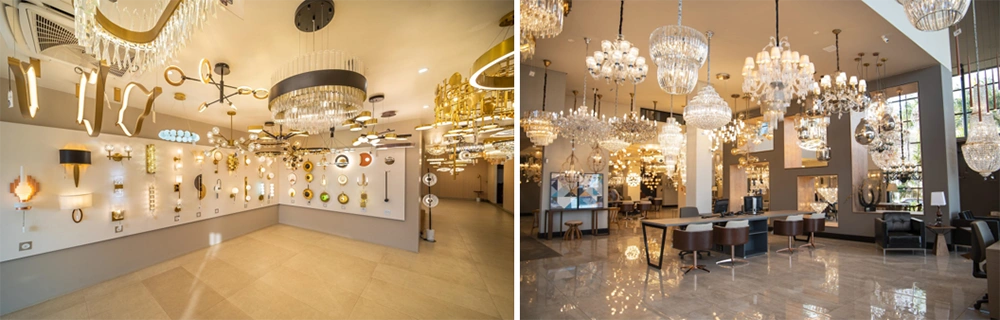
Decorative Lighting Styles
1) Different Installation Positions
The easiest way to understand the classification of decorative lighting is by looking at where it is installed.
Both chandeliers and pendant lights are installed on the ceiling, but their structures differ. Chandeliers are generally larger and more structurally complex, making them better suited as the visual focal point of a space. Pendant lights are usually smaller in size and can be installed individually or in multiple combinations, making them more suitable for highlighting specific areas.
Wall lights are mounted directly on the wall, occupying neither ceiling space nor floor space. They supplement wall illumination while adding visual depth to the space.
Table lamps are placed on furniture surfaces rather than mounted to the building. Their flexible positioning makes them suitable for bedside tables, desks, side tables, and reception counters without requiring structural installation.
Floor lamps require no fixed installation and can be freely repositioned according to the furniture layout, making them one of the most flexible decorative lighting fixtures.
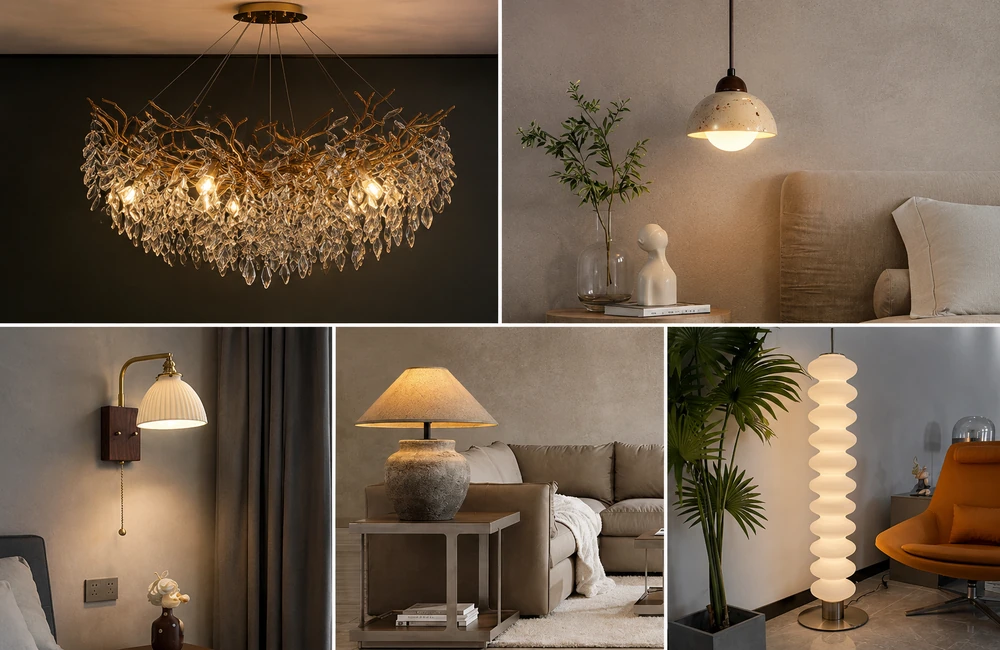
The Five Main Types of Decorative Lighting
2) Different Lighting Purposes
Besides installation position, different types of decorative lighting also serve different lighting functions.
General Ambient Lighting:
Large chandeliers typically feature multiple light sources, allowing them to illuminate a relatively large area. As a result, they are commonly used in open spaces such as living rooms, hotel lobbies, and banquet halls.
Task Lighting:
Pendant lights are typically installed above dining tables, bar counters, or kitchen islands, concentrating light on a specific area to provide more precise illumination.
Ambient Lighting:
Wall lights mainly serve as supplementary and ambient lighting. They reduce the monotonous effect of relying solely on ceiling lighting while adding depth and visual layering to the walls and surrounding space.
Localized Decorative Lighting
Table lamps are primarily used to provide comfortable close-range lighting for bedside tables, desks, and side tables. They also help strengthen the connection between lighting and furniture, making the overall interior feel warmer and more complete.
Flexible Supplementary Lighting:
Floor lamps provide flexible supplemental lighting. They can be repositioned according to the furniture layout to create comfortable illumination for reading areas, lounge spaces, or corners.
3) Different Spatial Requirements
Different spaces have different lighting requirements.
A hotel lobby usually features a higher ceiling and a larger spatial scale, requiring a large chandelier to create a strong visual focal point and enhance the overall sense of grandeur.
Dining areas place greater emphasis on tabletop illumination, making pendant lights one of the most common choices. They concentrate light over the dining area while creating a comfortable dining atmosphere.
Corridors are generally narrow spaces, where wall lights provide continuous illumination without occupying circulation space.
Bedrooms, hotel guestrooms, study rooms, and reception lounges commonly use table lamps to provide localized lighting while complementing surrounding furniture and soft furnishings.
Living rooms and reading corners are better complemented by floor lamps, which provide localized lighting while allowing flexible positioning according to the furniture layout.
4) Different Types Complement Rather Than Replace Each Other
In most complete lighting projects, only one type of decorative lighting is rarely used on its own.
A statement chandelier establishes the overall style of the lobby, guest rooms are complemented with wall lights, table lamps and floor lamps, dining areas are paired with coordinated pendant lights, and corridors are illuminated consistently with wall lights.
Each of these five types serves a distinct purpose and works together to create a complete layered decorative lighting system.
5. Decorative Lighting Comparison: Understanding the Differences
Although chandeliers, pendant lights, wall lights, table lamps, and floor lamps all belong to the category of decorative lighting, they differ significantly in terms of installation method, lighting performance, visual impact, and application scenarios. The following comparison highlights their key differences from several perspectives.
1) Compare by Structure
- Chandeliers:Suspended from the ceiling with a more complex structure and multiple light sources.
- Pendant Lights:Suspended from the ceiling with a simpler structure, designed for localized illumination.
- Wall Lights:Mounted directly on the wall, making full use of vertical space.
- Table Lamps: Freestanding fixtures placed on tables or furniture surfaces without requiring permanent installation.
- Floor Lamps:Freestanding fixtures that require no fixed installation and can be easily repositioned.
2) Compare by Lighting Effect
- Chandeliers:Provide wide-area illumination while serving as the visual focal point of a space.
- Pendant Lights:Deliver precise localized lighting, making them ideal for dining tables, bar counters, and similar areas.
- Wall Lights:Provide soft supplementary lighting that enhances the visual depth of a space.
- Table Lamps: Provide close-range lighting for bedside use, reading, and decorative ambient lighting.
- Floor Lamps:Offer flexible localized illumination for reading corners, lounge areas, and relaxation spaces.
3) Compare by Visual Characteristics
- Chandeliers:Have the strongest visual presence and often become the primary decorative element within a space.
- Pendant Lights:Emphasize specific areas and can be installed individually or in groups to create visual rhythm.
- Wall Lights:Highlight wall details while enhancing the spatial layering.
- Table Lamps: Blend naturally with furniture while enhancing decorative detail and visual warmth.
- Floor Lamps:Combine the functions of both lighting fixtures and furniture, blending naturally into the interior layout.
4) Compare by Typical Applications
- Chandeliers:Hotel lobbies, banquet halls, double-height living rooms, and reception areas.
- Pendant Lights:Dining tables, bar counters, kitchen islands, cafés, and restaurants.
- Wall Lights:Corridors, staircases, bedside areas, vanity mirrors, and hotel guest rooms.
- Table Lamps: Bedside tables, desks, side tables, hotel guestrooms, lounges.
- Floor Lamps:Living rooms, lounge areas, reading corners, and hotel guest rooms.
6) Comparison Summary
Based on Postmodernlighting’s project experience, we have summarized the key differences between the main decorative lighting types below for quick reference.
| Feature | Chandeliers | Pendant Lights | Wall Lights | Table Lamps | Floor Lamps |
| Installation Method | Ceiling suspended, often requiring pre-installed mounting support | Ceiling suspended with flexible positioning | Wall mounted with junction box installation | Freestanding on tables, desks, or bedside cabinets | Freestanding |
| Lighting Coverage | Wide-area general lighting | Zone lighting | Local lighting | Close-range localized lighting | Localized supplementary lighting |
| Visual Presence | Strong visual focal point | Creates visual rhythm when grouped | Subtle, low-profile appearance | Complements furniture and soft furnishings | Moderate, complements soft furnishings |
| Suitable Space | Large spaces | Medium and small spaces | Wall areas | Tabletops, bedside cabinets, desks, side tables | Floor areas |
| Flexibility | Fixed installation | Adjustable suspension height | Fixed installation | Highly movable | Movable |
| Primary Function | Statement piece and general lighting | Localized task lighting | Ambient and accent lighting | Localized lighting and decorative furnishing | Ambient lighting |
| Typical Applications | Hotel lobbies, banquet halls, staircases | Dining tables, bar counters, kitchen islands | Corridors, bedside areas, bathrooms | Hotel guestrooms, bedrooms, studies, reception desks | Living rooms, lounge areas, reading corners |
6. Conclusion
Understanding the differences between these lighting types not only helps establish a comprehensive understanding of decorative lighting as a whole, but also makes it easier to identify the characteristics and suitable applications of each product.
If you are planning decorative lighting for hotels, villas, restaurants, commercial projects, or wholesale distribution, Postmodern Lighting can support you with a wide range of chandeliers, pendant lights, wall lights, table lamps, and floor lamps. Feel free to submit your project requirements, drawings, or preferred styles, and our team will help recommend suitable decorative lighting solutions for your space.