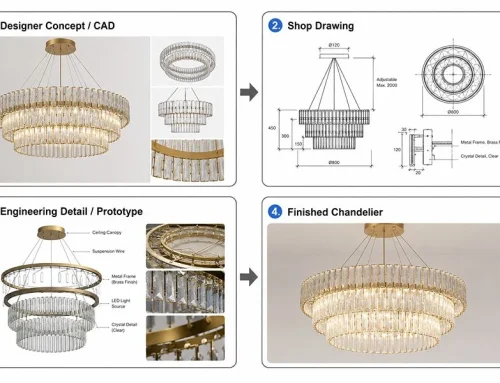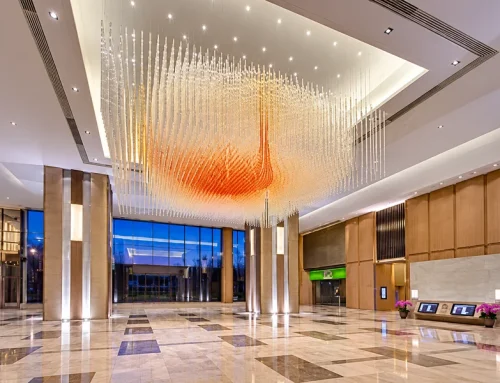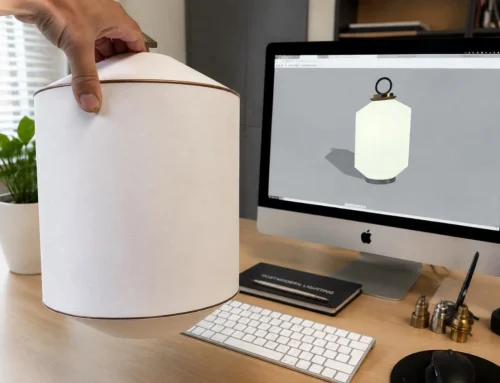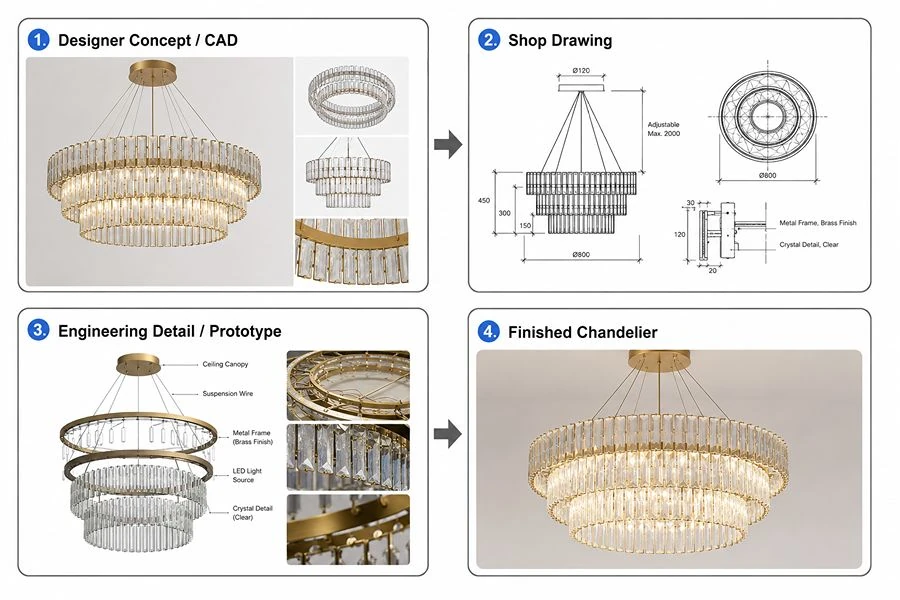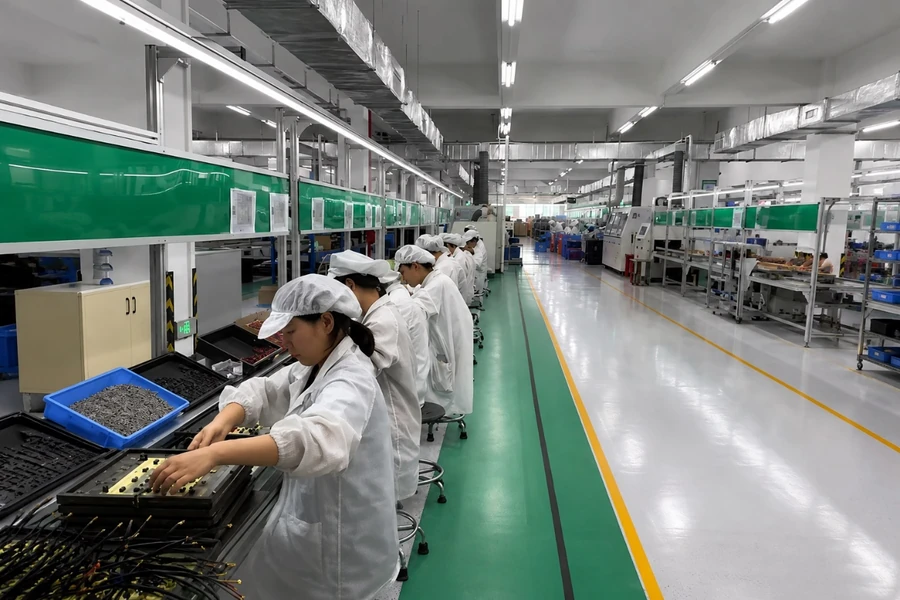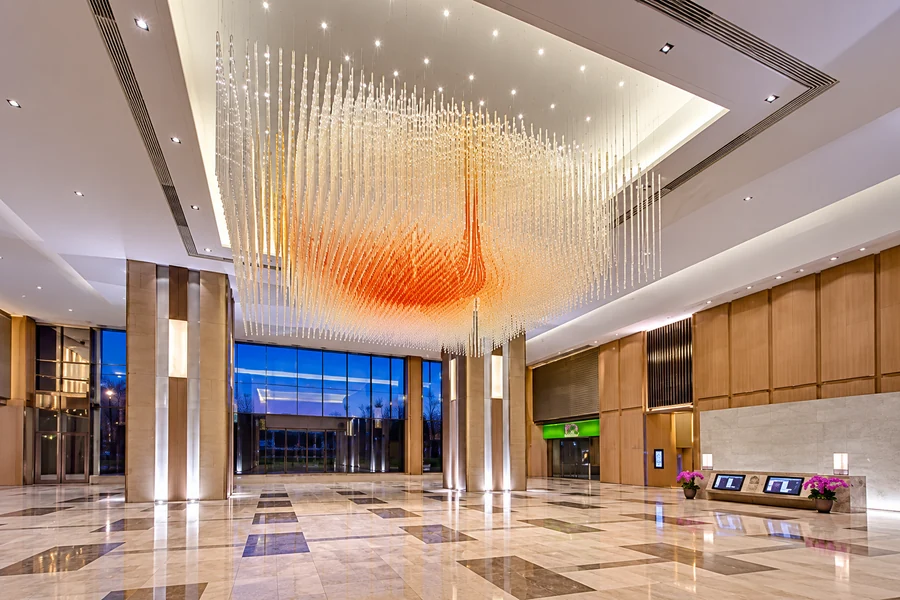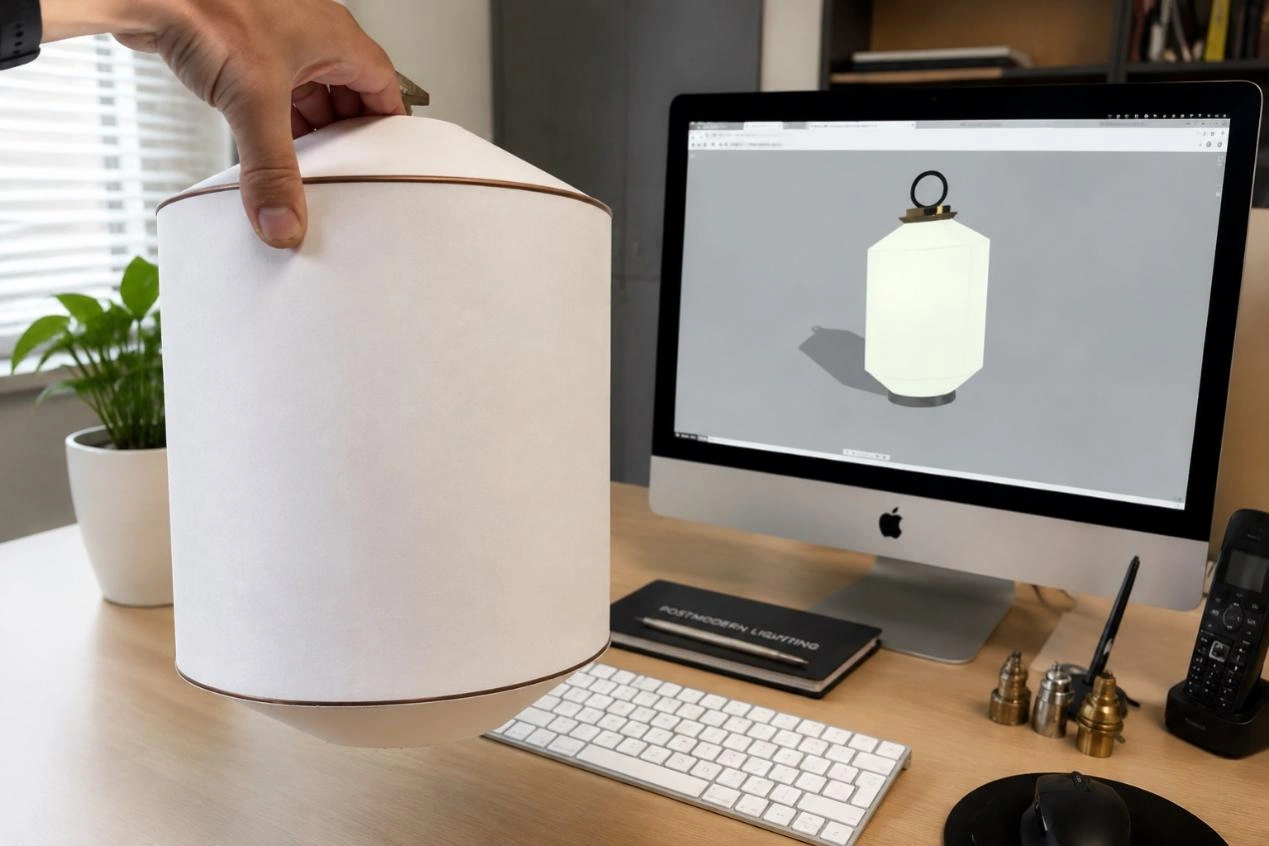
Decorative lighting materials are often selected for their appearance first, but in real projects, material choice affects much more than style. From crystal and glass to brass, marble, acrylic, and metal structures, each material has its own optical performance, weight, manufacturing limits, maintenance requirements, and project risks. This guide explains the key materials used in decorative lighting and how to select them more professionally for hotels, villas, restaurants, and commercial spaces.
1. Why Decorative Lighting Materials Matter More Than Most Buyers Think
When selecting decorative lighting, many buyers simply associate materials with appearance—crystal looks luxurious, brass feels premium, marble adds elegance, and metal is merely seen as the supporting structure.
In reality, materials influence far more than aesthetics. They directly affect lighting performance, structural safety, manufacturing complexity, installation requirements, transportation risks, service life, and long-term maintenance costs.
Rather than asking “Which material is the most premium?”, professional lighting manufacturers first evaluate the project environment, installation conditions, ceiling structure, maintenance capability, and budget to determine which material is the most suitable. Even the highest-end material can become a safety risk or an unnecessary cost if used in the wrong application.
2. Crystal: Outstanding Optical Performance Comes with Higher Structural Requirements
Decorative lighting crystal is typically not natural crystal, but a highly transparent engineered glass material, such as lead crystal, K9 crystal, or other optical glass.
Lead crystal generally contains approximately 24–30% lead oxide, which increases its refractive index, weight, and machinability. K9 crystal, on the other hand, is a lead-free optical glass known for its excellent transparency and optical clarity.
Compared with ordinary glass, the key difference is not simply higher transparency, but significantly stronger light refraction and dispersion.
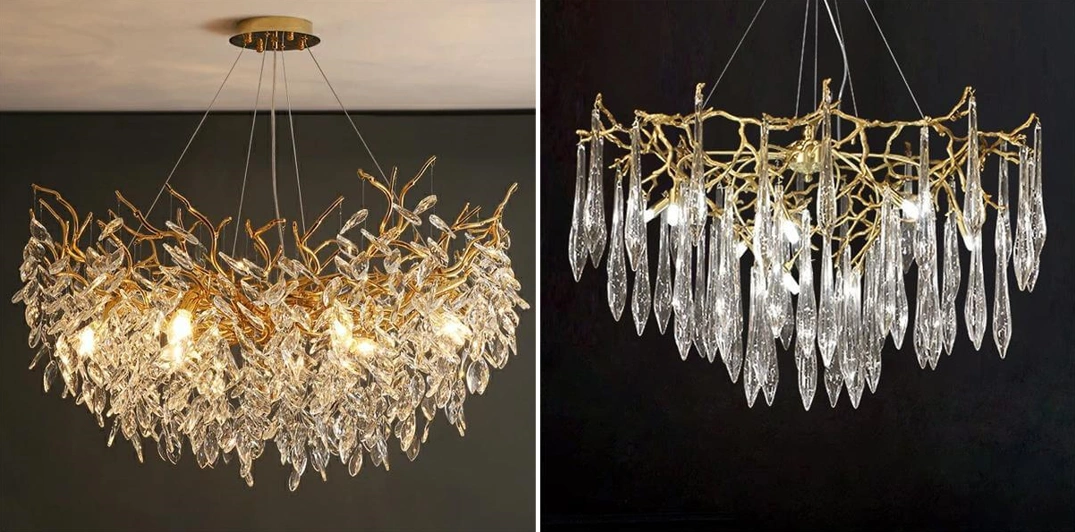
Crystal Lighting Fixture
1) Why Does Crystal Produce Its Signature Sparkle?
The brilliance of crystal lighting comes from three key factors:
- High refractive index (Lead Crystal > K9 Crystal)
- Precision cutting angles
- Light dispersion
Unlike ordinary transparent materials that simply allow light to pass through, precisely cut crystal refracts and reflects light from multiple angles, separating white light into a spectrum of colors and creating a rich sparkling effect.
In other words, crystal is valued not because it is transparent, but because it transforms a single light source into layered, dynamic lighting.
2) The Engineering Challenges of Crystal Lighting
Crystal’s greatest advantage also creates its biggest engineering challenge—weight.
As more crystal components are added, the overall fixture weight does not increase proportionally. Additional crystals usually require a larger metal frame, more suspension components, and stronger supporting hardware.
For large hotel chandeliers, the primary design concern is no longer the amount of crystal used, but whether the structure can safely support it.
Key engineering considerations include:
- Whether the ceiling can support the fixture weight
- Whether additional embedded steel structures are required
- Whether the suspension points are properly distributed
- Whether suspension cables, rods, and connectors meet safety requirements
- Whether future cleaning and maintenance are practical
For example, increasing the amount of crystal by 30% may increase the total fixture weight by more than 30%, since the supporting frame and mounting hardware also need to be reinforced.
A crystal chandelier is therefore not simply about adding more crystal—it must be designed together with structural calculations and installation conditions.
3) What Buyers Often Overlook
In Postmodernlighting’s past projects, we have seen some buyers focus mainly on the number of crystal pieces, believing that more crystal automatically means a more luxurious fixture.
In reality, the overall quality of a crystal chandelier depends far more on:
- Crystal cutting precision (premium products typically maintain angle tolerances within 0.8°, while standard products may exceed 3°)
- Drilling accuracy, which affects hanging alignment and light distribution
- Material consistency between production batches to avoid visible color or brightness differences
- Factory weight-balancing tests to prevent uneven loading and installation issues
3. Glass: The Most Widely Used Material in Modern Decorative Lighting
Glass used in decorative lighting is not a single material, but a broad category that can be processed in various ways to create different lighting effects.
It may include clear glass, frosted glass, opal glass, ribbed glass, blown glass, pressed glass, cast glass, or bent glass.
Unlike crystal, glass is not primarily intended to maximize sparkle. Instead, it offers greater control over light diffusion, visual comfort, and overall atmosphere.
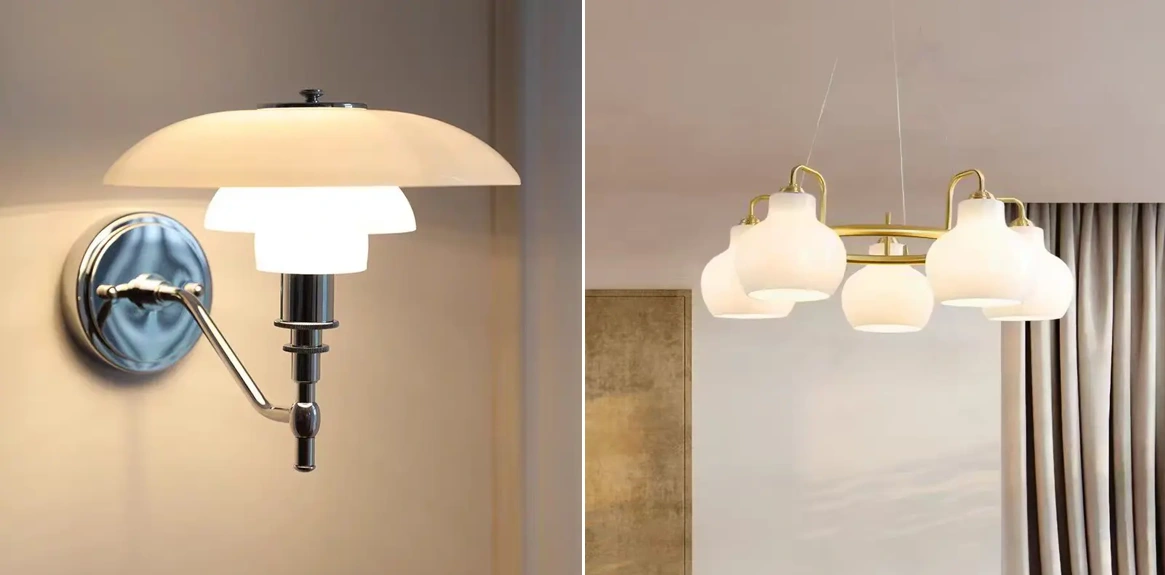
Glass Light Fixture
1) Common Types of Glass and Their Lighting Effects
Clear glass highlights the light source and metal structure, making it popular for vintage pendants, linear lighting, and restaurant fixtures. Its main advantage is transparency, although it can also produce noticeable glare.
Frosted glass softens direct light through surface treatment, creating a more comfortable lighting experience.
Opal glass provides stronger light diffusion, effectively concealing LED modules or bulbs while producing a more uniform illumination.
Ribbed and textured glass not only add decorative texture but also redirect light, creating richer layers of light and shadow. In the lighting industry, both ribbed glass and opal glass are widely used to reduce glare, improve light diffusion, and create a warmer ambiance.
2) Glass Manufacturing Processes
Common manufacturing methods include glass blowing, pressing, bending, casting, and frosting.
Blown glass is ideal for handcrafted pendant and wall lights with organic forms.
Pressed glass offers excellent dimensional consistency, making it suitable for large production runs.
Bent glass enables curved and wave-shaped designs, while cast glass is commonly used in heavy decorative lighting with an artistic appearance.
Different manufacturing processes determine dimensional consistency, optical quality, production cost, and the complexity of achievable designs.
3) Limitations of Glass
Glass is inherently fragile and requires careful packaging and transportation.
Large glass shades demand strict control over thickness tolerances and edge finishing. Differences in glass thickness, color, or diffusion formulation may also lead to inconsistent lighting performance across the same project.
4) What Buyers Often Overlook
Even if two fixtures use opal glass, their lighting performance may differ significantly.
The difference may come from the diffusion formula, glass thickness, surface treatment, or light transmittance rather than the glass color itself.
Thicker glass does not necessarily indicate higher quality.
When sourcing glass lighting fixtures, buyers should evaluate the illuminated performance rather than appearance alone. Viewing illuminated samples and requesting light uniformity test reports is strongly recommended.
4. Acrylic: An Important Lightweight Alternative for Modern Decorative Lighting
Acrylic is a transparent thermoplastic material known for its light weight, high light transmission, and excellent machinability. Although it is often referred to as “organic glass,” it is fundamentally a polymer rather than real glass.
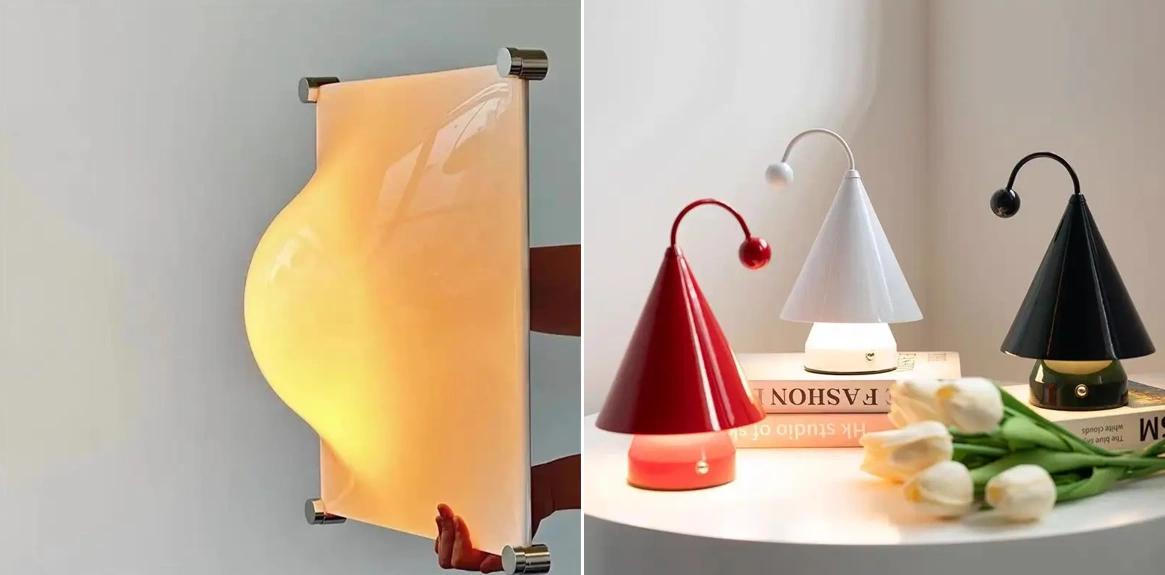
Acrylic Lighting Fixture
1) Why Is Acrylic Increasingly Used in Modern Lighting?
Compared with glass, acrylic is better suited for large and complex decorative lighting structures, including:
- Extra-long linear pendants
- Large circular ring lights
- Irregular artistic lighting installations
Replacing glass with acrylic can significantly reduce fixture weight, making transportation, installation, and suspension much easier.
2) Limitations and Key Considerations
Acrylic also has several limitations:
- The surface is more susceptible to scratches.
- Long-term exposure to high temperatures may accelerate aging.
- Optical clarity is generally lower than that of premium glass.
- Standard PMMA may gradually yellow after prolonged UV exposure.
Whenever possible, optical-grade PMMA with UV-resistant treatment should be specified, as it offers higher light transmission, fewer impurities and bubbles, improved light uniformity, and better long-term durability.
For this reason, premium hotels and artistic decorative lighting still rely heavily on glass, while acrylic is widely used in commercial offices, retail environments, and minimalist lighting designs.
5. Brass: Why Luxury Hotels Still Prefer Brass
Brass is an alloy primarily composed of copper and zinc, widely used for lamp arms, fixture bodies, ceiling canopies, decorative elements, and connectors in premium decorative lighting.
Its long-standing popularity is not simply due to its warm golden appearance, but because it combines excellent machinability, substantial weight, refined texture, and long-term restorability.
Compared with stainless steel, brass offers a warmer, softer, and more sophisticated metallic finish, making it particularly suitable for luxury interior projects.
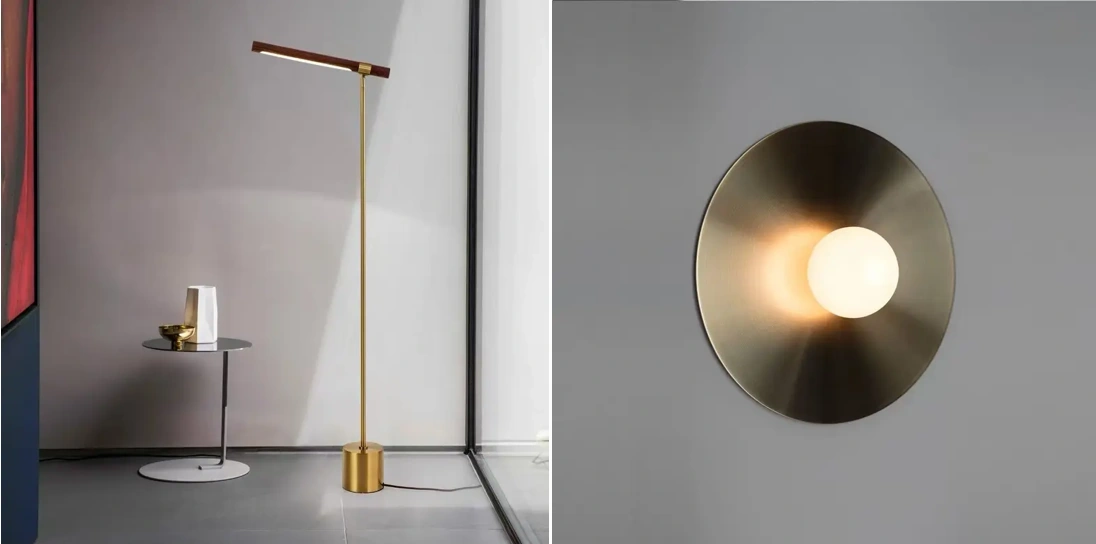
Brass Light Fixture
1)Solid Brass vs. Brass-Plated
Solid brass means the entire component is made from brass, while brass-plated components typically use steel, zinc alloy, or other base metals with a brass-colored plated finish.
Although both may look nearly identical when new, the differences become increasingly noticeable over time.
Solid brass is heavier and more expensive but can be refinished multiple times through polishing or surface restoration. Brass-plated components are more economical and provide consistent color initially, but once the plating wears, scratches, or corrodes, the underlying metal may become exposed and is often difficult to restore.
2)Surface Finishes and Patina
Common brass finishes include Satin Brass, Antique Brass, Brushed Brass, Polished Brass, and Living Brass.
Living Brass refers to unfinished or minimally protected brass that naturally develops a patina over time through exposure to air, humidity, and human touch.
Many luxury hotels and vintage-style interiors intentionally embrace this natural aging process, as it creates a richer, more authentic character rather than maintaining a permanently polished appearance.
However, Living Brass is not suitable for every project. In environments such as hospitals, offices, and other spaces that emphasize cleanliness and visual consistency, the naturally aged appearance may be perceived as wear rather than design.
3)What Buyers Often Overlook
Do not judge brass fixtures solely by their appearance.
The most important question is whether the visible brass components are solid brass or merely brass-plated.
Unlike solid brass, plated brass cannot be effectively refinished once the surface coating deteriorates, making it a common long-term maintenance issue in luxury hospitality projects.
6. Marble: Premium Aesthetics Come with Engineering Challenges
Marble is a natural stone widely used for lamp bases, fixture bodies, decorative panels, and shades in decorative lighting.
Its appeal comes from its unique natural veining, substantial weight, and luxurious appearance. Since every slab of natural marble is unique, this also creates challenges in achieving consistency across large production batches.
In decorative lighting, marble is rarely used as the sole structural material. Instead, it is typically combined with metal, glass, or acrylic to balance aesthetics with structural performance.
For pendant lights and wall lights in particular, thick marble components can significantly increase fixture weight and transportation risks.
Many products marketed as Marble Lamps are not made from solid marble, but instead use stone veneer or ultra-thin stone composites to reduce weight while preserving the natural stone appearance.
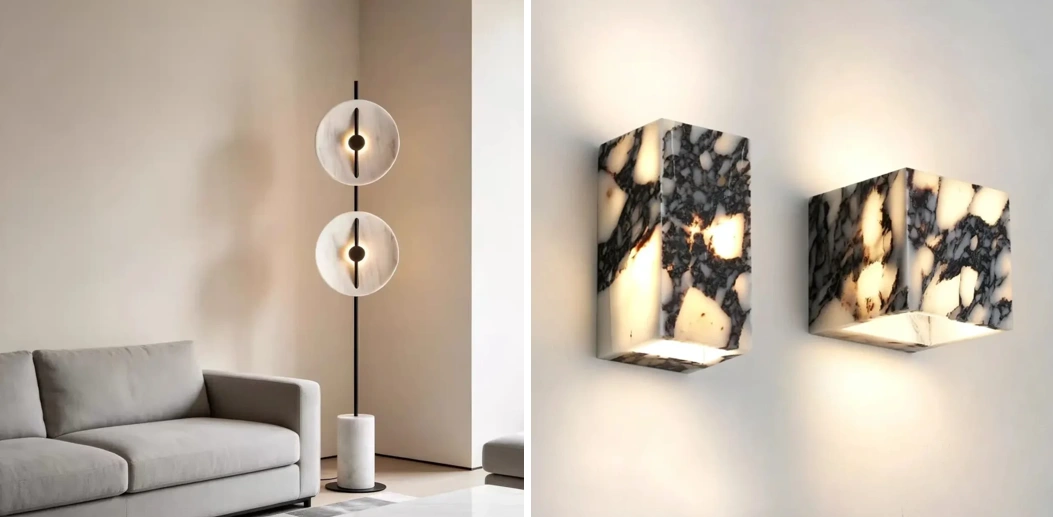
Marble Light Fixture
1) Natural Marble vs. Engineered Stone
The difference between natural marble and engineered stone goes far beyond price.
The key distinctions include:
- Visual consistency:Every piece of natural marble features unique veining, making batch consistency difficult. Engineered stone provides a much more uniform appearance.
- Structural stability:Natural marble may contain microscopic fissures and natural imperfections that increase the risk of cracking, whereas engineered stone generally offers better structural consistency.
- Manufacturing flexibility:Natural marble is brittle and produces higher processing waste, while engineered stone is easier to machine into complex shapes.
2) Why Are Marble Fixtures More Difficult to Transport and Install?
The greatest engineering challenges of marble are its weight and brittleness.
Natural marble typically has a density of approximately 2,600–2,800 kg/m³, depending on the specific stone type.
Even relatively small marble components can add considerable weight to a lighting fixture, affecting structural design, packaging, shipping, and installation.
For example, a marble panel measuring 300 × 300 × 20 mm weighs approximately 4.9 kg at a density of 2,700 kg/m³.
While this may be acceptable for a single lamp base, the total weight increases rapidly when multiple stone components are incorporated into chandeliers, linear pendants, or large decorative installations.
3) What Buyers Often Overlook
The durability of a marble lighting fixture depends less on the stone itself than on the structural system supporting it.
Before purchasing, buyers should confirm:
- Marble thickness
- Internal metal reinforcement
- Mounting method
- Crack-prevention design
- Batch consistency of color and veining
- Packaging suitable for international transportation
7. Metal Construction: The Hidden Foundation of Decorative Lighting
In decorative lighting, Metal Construction refers not only to the visible metal finish but also to the complete structural system inside the fixture, including the frame, arms, canopy, suspension rods, connectors, mounting plates, threaded fasteners, and load-bearing components.
Although often hidden from view, these elements largely determine the fixture’s structural stability, safety, and service life.
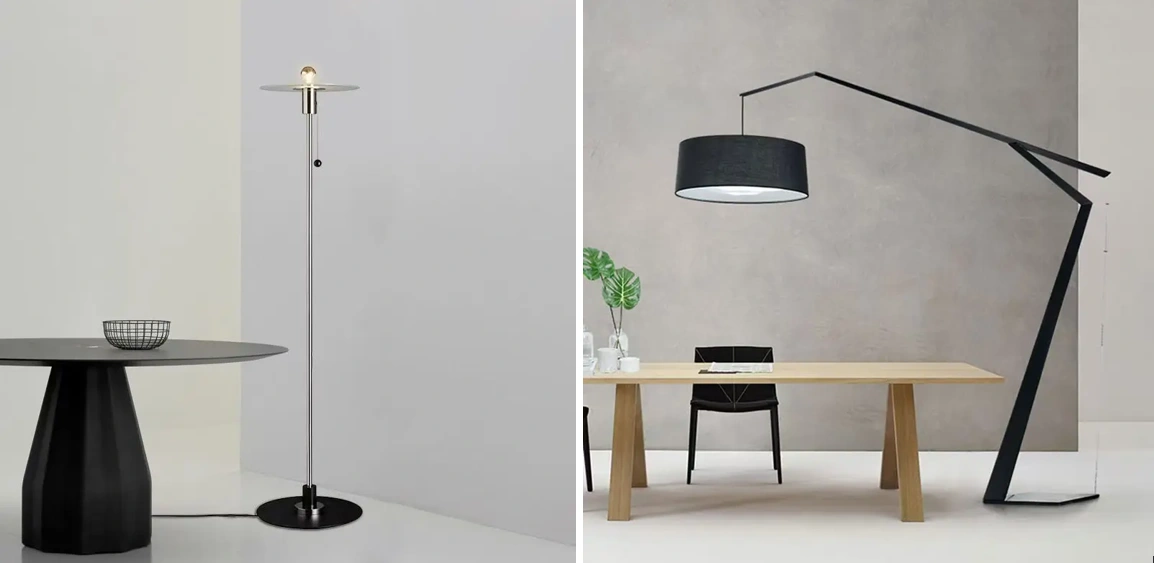
Decorative Lighting Metal Structure
1) What Does the Metal Structure Do?
Metal construction generally performs four essential functions.
Load bearing ensures that chandeliers, wall lights, and large linear fixtures remain structurally stable.
Connection securely joins materials such as glass, crystal, marble, and acrylic into a single integrated fixture.
Heat dissipation helps transfer heat away from LED boards, drivers, and power supplies, improving long-term reliability.
Structural rigidity prevents sagging, deformation, or misalignment in long linear fixtures, circular pendants, and large decorative installations.
Choosing Between Steel, Aluminum, Stainless Steel, and Brass
| Material | Weight | Strength | Corrosion Resistance | Cost | Typical Applications |
| Steel | Medium to Heavy | High | Depends on surface treatment | Low | Structural frames and heavy-duty support |
| Aluminum | Light | Medium | Good | Medium | Linear fixtures, lightweight structures, modern lighting |
| Stainless Steel | Medium to Heavy | High | Excellent | High | Coastal, humid, and corrosion-resistant projects |
| Brass | Heavy | Medium | Good | High | Decorative components, lamp arms, exposed metal details |
2) What Buyers Often Overlook
The long-term durability of a lighting fixture depends less on its surface finish than on its structural design.
Critical factors include weld quality, wall thickness, connection methods, and reinforcement design.
Some fixtures appear perfectly stable during installation but gradually develop sagging arms, deformed canopies, or loose glass components after years of service.
For example, two steel tubes may look identical, yet increasing the wall thickness from 1.2 mm to 2.0 mm can significantly improve bending resistance, load capacity, and long-term dimensional stability.
Instead of evaluating decorative lighting solely by appearance, buyers should also review structural drawings, installation methods, and the specifications of critical metal components.
8. Why Modern Decorative Lighting Increasingly Combines Multiple Materials
Well-designed decorative lighting rarely relies on a single material.
Although fixtures made entirely of crystal, brass, or marble may sound luxurious, they are often impractical in terms of manufacturing, transportation, installation, and long-term maintenance.
Today, decorative lighting is more commonly built using combinations of materials, such as:
- Brass + Glass
- Steel + Crystal
- Marble + Brass
- Aluminum + Acrylic
- Stainless Steel + Glass
- Brass + Opal Glass
The reason is simple—each material serves a different purpose.
Brass provides a premium metallic appearance; steel delivers structural strength; aluminum reduces weight; glass diffuses light and creates atmosphere; crystal enhances sparkle through refraction; and marble contributes natural texture and a luxurious aesthetic.
For example, a large crystal chandelier in a hotel lobby may appear to be made primarily of crystal, but the actual load-bearing structure is usually steel. Brass or brass-finished components provide the decorative details, while the crystal is responsible only for the optical effect.
Similarly, a marble wall light may appear to be made entirely of stone, yet its long-term stability depends on the concealed metal backplate and supporting structure behind it.
Modern decorative lighting increasingly relies on functional material integration rather than a single premium material.
9. Five Common Material Selection Mistakes in Decorative Lighting Projects
Based on more than a decade of project experience, Postmodernlighting has summarized several common material selection mistakes in decorative lighting projects. These examples can help buyers better understand potential risks and avoid similar problems during design, sourcing, production, and installation.
1) Focusing on Appearance While Ignoring Weight
Project Scenario
A commercial lobby selected a large multi-tier crystal chandelier based solely on its visual impact, without calculating the fixture weight or verifying the ceiling’s load-bearing capacity.
Problem
The fixture exceeded the ceiling’s structural limit, requiring reinforcement of the suspended ceiling, additional mounting points, and significant rework, resulting in project delays and increased costs.
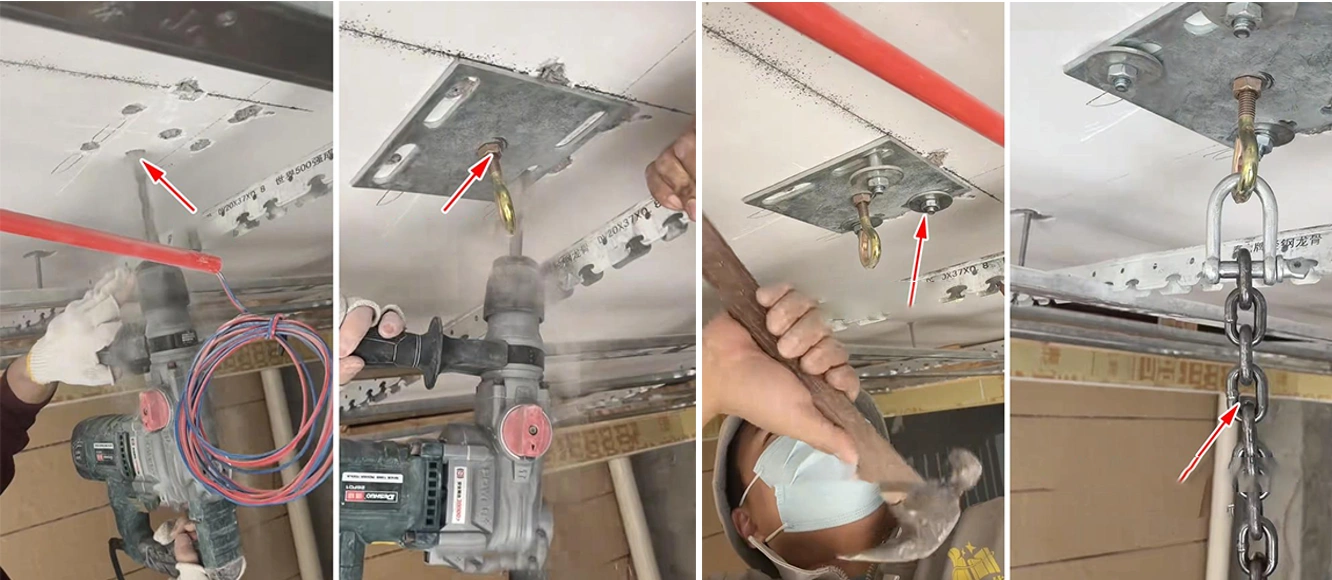
Ceiling Rework After Incorrect Material Selection
Best Practice
For heavy decorative fixtures, verify the total weight during the design stage and coordinate with structural engineers to ensure that aesthetics, weight, and structural capacity are properly matched.
2) Mistaking Brass-Plated Components for Solid Brass
Project Scenario
A luxury clubhouse selected brass-plated lighting fixtures to reduce costs. The appearance was almost identical to solid brass, and no issues were found during installation.
Problem
After several months of use, the plated surface became scratched, discolored, and peeled. Since the finish could not be restored, the fixtures required complete replacement, significantly increasing maintenance costs.
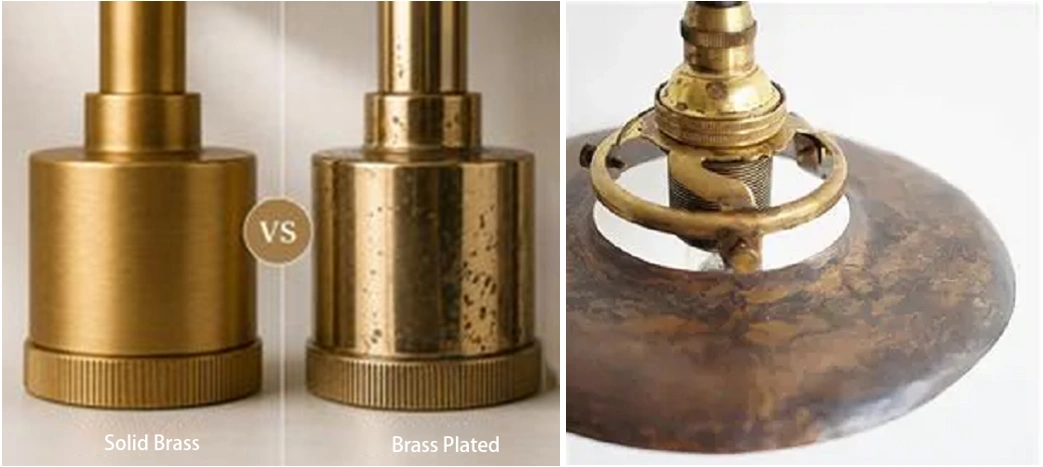
Solid Brass vs. Brass-Plated
Best Practice
Always confirm whether visible brass components are Solid Brass or Brass Plated. For high-touch or highly visible commercial areas, solid brass is generally the better long-term investment.
3) Using Natural Marble Everywhere Without Considering Transportation Risks
Project Scenario
A luxury villa project specified thin natural marble lighting fixtures throughout the property without internal reinforcement or specialized protective packaging.
Problem
Multiple fixtures cracked or chipped during transportation. Natural variations in veining also resulted in inconsistent visual appearance after installation.
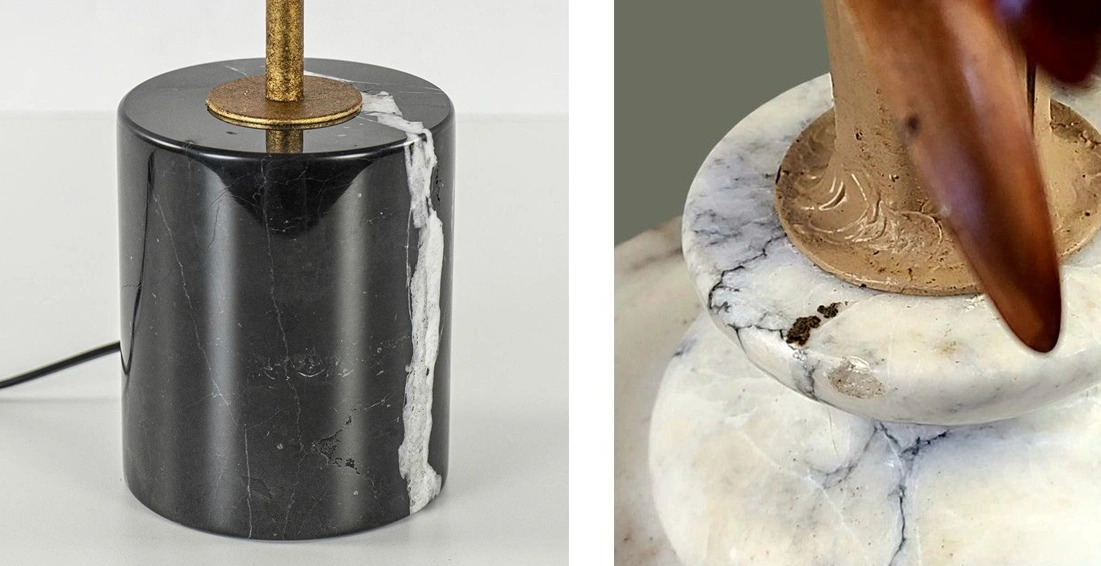
Damaged Marble Lamp Base
Best Practice
Large or irregular marble fixtures should incorporate internal metal reinforcement and professional shock-resistant packaging. For large projects, engineered stone may provide a better balance between appearance and consistency.
4) Installing Large Crystal Chandeliers Without Considering Maintenance
Project Scenario
A five-star hotel selected a large crystal chandelier for its lobby and calculated only the purchasing and installation costs.
Problem
Over time, dust accumulation reduced the chandelier’s brilliance. Cleaning required specialized equipment and professional maintenance crews, resulting in substantial annual maintenance expenses.
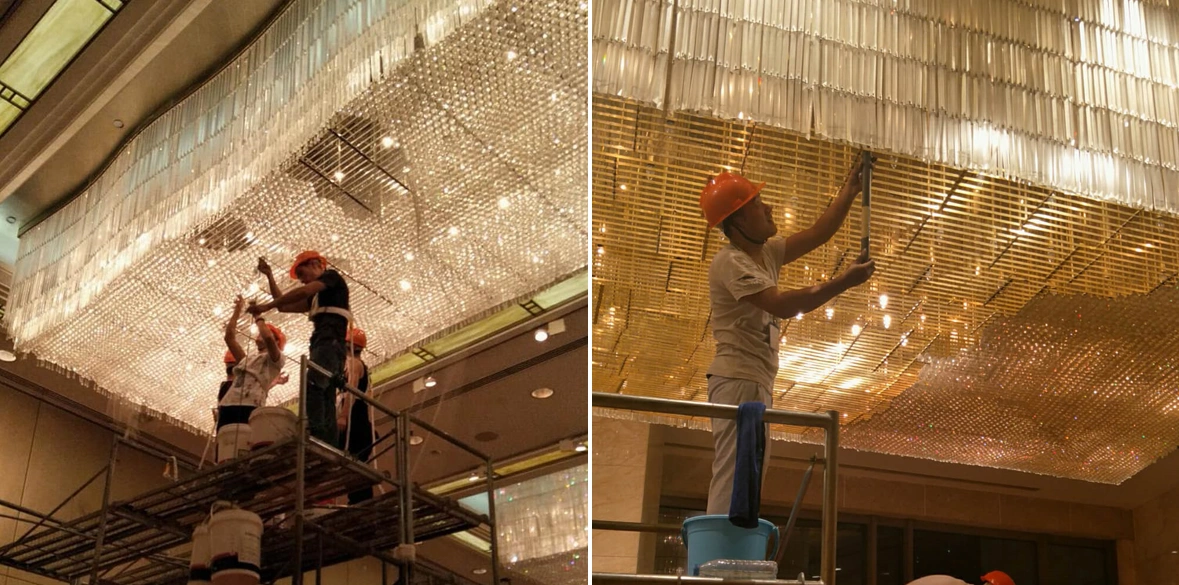
Crystal Chandelier Cleaning
Best Practice
Maintenance costs should be considered during the design stage. In high-ceiling spaces, selecting crystal fixtures with easier access and simpler construction can significantly reduce long-term operating costs.
5)Mismatching Material Weight and Structural Support
Project Scenario
A commercial decorative lighting project combined heavy crystal and marble components with ultra-thin suspension cables and a lightweight internal frame to achieve a minimalist appearance.
Problem
After installation, uneven loading caused the fixture to tilt, suspension cables to deform, and connectors to loosen, creating both aesthetic issues and potential safety hazards.
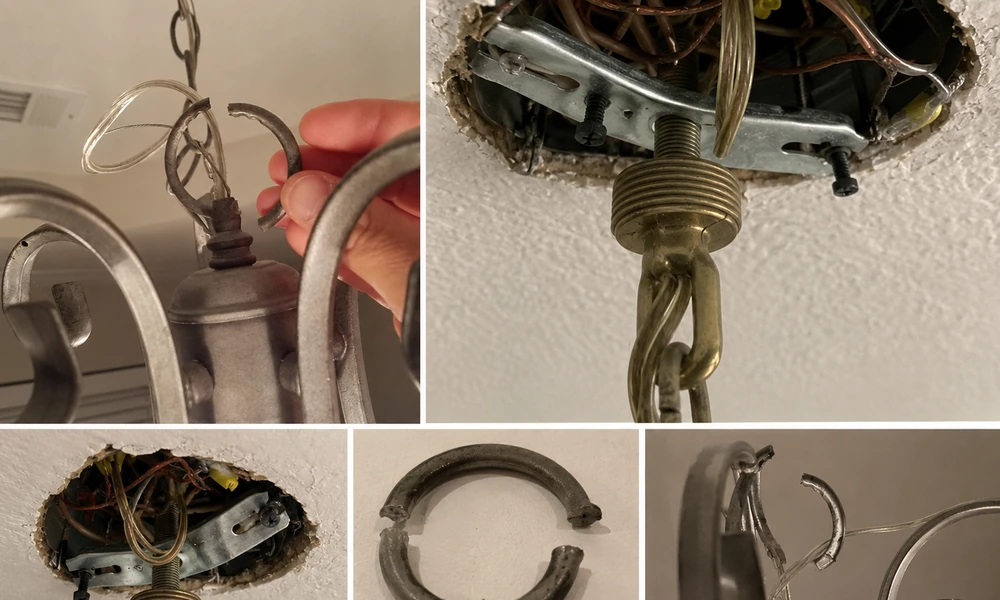
Lighting Structure Failure
Best Practice
Always follow the principle of matching heavy materials with appropriately engineered support structures. Crystal and marble fixtures should be designed with properly rated suspension cables, sufficient mounting points, and reinforced internal frames, with structural calculations completed before production.
10. Material Selection for Different Decorative Lighting Projects
Based on Postmodernlighting’s project experience and customer purchasing feedback, we have summarized the following matrix to help buyers quickly compare different decorative lighting materials in terms of optical performance, structural safety, manufacturing feasibility, service life, maintenance, and budget impact.
Material Performance Matrix
| Material | Optical Performance | Structural Safety | Manufacturing | Service Life | Maintenance | Budget Impact |
| Crystal | Creates strong visual impact and luxurious lighting effects | Heavy; ceiling load calculations are essential for large fixtures | Requires high cutting, drilling, and assembly precision | Stable material, but connectors require periodic inspection | Frequent cleaning and relatively high maintenance costs | High purchasing, installation, and maintenance costs |
| Glass | Offers transparent, diffused, and soft lighting effects | Moderate weight; relatively easy to install but requires careful handling | Mature manufacturing processes including blowing, pressing, bending, and casting | Excellent stability when properly manufactured | Easy to clean and replace | Cost-effective for most decorative lighting projects |
| Acrylic | High light transmission with uniform light diffusion | Lightweight; ideal for large fixtures but requires reinforcement for long spans | Easy to cut, thermoform, engrave, and fabricate | UV-resistant PMMA provides better long-term stability | Easy to clean but more susceptible to surface scratches | Lower transportation and installation costs than glass |
| Brass | Primarily enhances visual quality rather than lighting performance | Suitable for structural and decorative components, but relatively heavy | CNC machining, casting, polishing, brushing, and antiquing are well established | Solid brass can be refinished repeatedly | Easy to maintain with appropriate surface protection | Higher initial investment with strong long-term value |
| Marble | Provides natural texture and premium appearance | Usually requires concealed steel reinforcement | High manufacturing and transportation complexity | Long-lasting but vulnerable to impact damage | Difficult to repair if damaged | Higher material, transportation, and installation costs |
| Aluminum | Ideal for minimalist and contemporary designs | Lightweight and reduces installation loads | Easily extruded, machined, powder coated, and anodized | Good indoor corrosion resistance | Low maintenance | Reduces transportation and installation costs |
| Steel | Provides structural support rather than optical performance | Highest load-bearing capacity | Mature welding, bending, coating, and fabrication processes | Service life depends on corrosion protection | Low maintenance when properly protected | Excellent structural cost-performance ratio |
Understanding the characteristics of individual materials is only the first step. Actual material selection should always be based on project requirements.
Different commercial environments have different expectations for lighting performance, maintenance, installation, and budget, meaning there is no universal material combination.
The following recommendations provide a practical reference for common project types.
Recommended Material Combinations for Different Decorative Lighting Projects
| Project Type | Recommended Material Combination | Primary Reason |
| Hotel Lobby | Brass + Crystal | Creates a luxurious focal point with strong visual impact |
| Boutique Hotel | Brass + Glass | Warm appearance with lower maintenance requirements |
| Restaurant | Glass + Metal | Soft lighting, easy maintenance, and comfortable ambiance |
| Luxury Villa | Marble + Brass | Combines natural texture with premium metallic finishes |
| Commercial Office | Aluminum + Glass | Lightweight, modern, and suitable for linear lighting |
| Coastal Hotel | Stainless Steel + Glass | Superior corrosion resistance and easier maintenance |
| Retail Space | Metal + Glass / Acrylic | Flexible customization with efficient installation |
These recommendations should be considered as selection guidelines rather than fixed rules.Final material choices should also account for ceiling height, structural conditions, maintenance access, transportation requirements, and the overall interior design concept.
11. Conclusion
Choosing the right material is only the beginning of a successful decorative lighting project. The final quality depends on how each material is engineered, manufactured, finished, assembled, and maintained after installation.
Before confirming a supplier’s proposal, buyers should look beyond the visible material name and review the engineering details behind it, including solid brass or brass-plated components, marble thickness and reinforcement, metal wall thickness, glass process, crystal type, structural load testing, repairability, and batch consistency.
If you are selecting materials for a hotel, villa, restaurant, or commercial lighting project, feel free to submit your design requirements to Postmodernlighting. Our team can help evaluate suitable material combinations and provide practical recommendations for appearance, structure, installation, and long-term maintenance.